Product Info Cable Carrier (CABLEVEYOR)
Cable Carrier (CABLEVEYOR) is a mechanical component that reliably supports and guides power, signal, and other cables and tubes that move along with the moving parts of equipment, protecting them from wear and tear.
Cables and tubes are passed through the main body, which has a chain-like link structure, and it moves independently at a constant bending angle between the moving and fixed parts.
Depending on the number of cables and tubes stored, installing a divider inside can prevent the contents from sliding against each other, extending the product's lifespan.
Materials include resin and steel, and they can handle linear motion, rotational motion, and three-dimensional motion.

Table of contents
Cable Carrier (CABLEVEYOR) related information


Structure and Features
- - Cables and hoses are stored inside the main body, providing orderly and reliable support and guidance without applying excessive force.
- - The bends are constant radius and bend in one direction only, protecting the cable/hose and maintaining its trajectory.
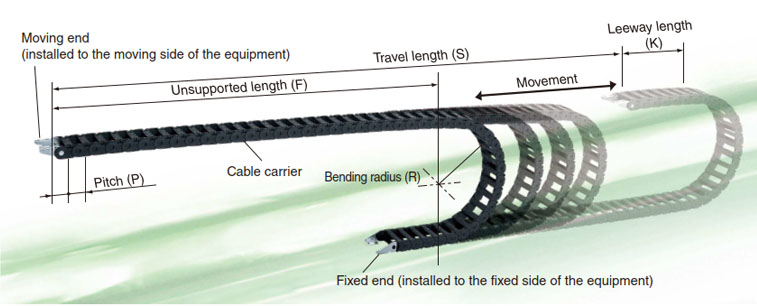
Explanation of terms (free span, travel length, Leeway length, bending radius, total height, installation height, required space, Leeway space)
Unsupported length (F)
The distance from the moving end to the apex of the bend, and is the length that Cable Carrier (CABLEVEYOR) can stand on its own.
The allowable length varies depending on the product type, so please check Allowable load graph on each product page.
Travel length (S)
Cable Carrier (CABLEVEYOR) It is travel distance between two points where the moving end (the moving part of the device) reciprocates.
Leeway length (K)
This is Cable Carrier (CABLEVEYOR) 's Leeway length to absorb installation dimensional errors.
This will vary depending on the variety and size, so please check the "Link Count Calculation" section on each product page.
Bending radius (R)
Cable Carrier (CABLEVEYOR) bends in a certain direction at a certain radius, which is called bending radius.
This is determined by variety and size, so please check each product page.
Allowable load graph
This graph shows the allowable range of unsupported length and travel length for cable/hose mass (kg/m). It can be used as long as the operating conditions are within the range of the broken line.
This varies depending on the type and size, so please check Allowable load graph on each product page when making your selection.
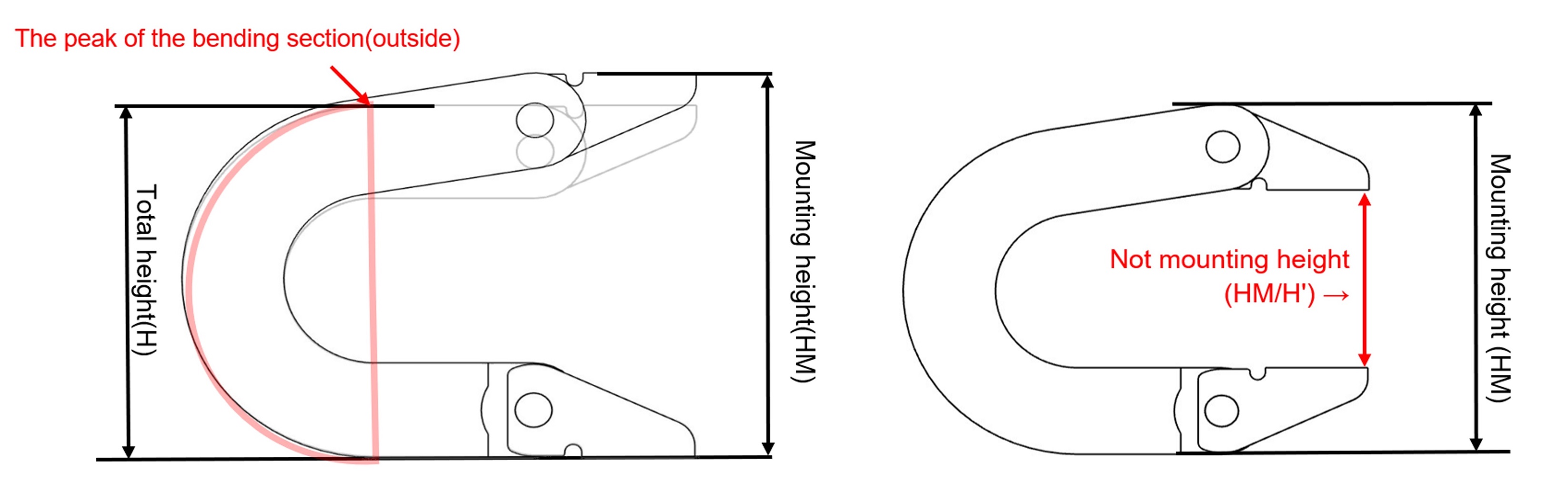
Total height (H)/Installation height (H')
- ・Total height (H): The height from the outer surface of the fixed end bracket to the apex of the bent part (outer periphery).
- ・Installation height (H'): The height from the outer surface of the fixed end bracket to the outer surface of the moving end bracket.
Cable Carrier (CABLEVEYOR) has a bulged structure to compensate for deflection in the free span caused by the weight of Cable Carrier (CABLEVEYOR) itself and the mass of the cables and hoses.
If installed at full height, the bulge will be suppressed, causing excessive force to be applied to Cable Carrier (CABLEVEYOR). This may shorten the life of Cable Carrier (CABLEVEYOR), so be sure to design and install at the installation height.

*Note: The installation height is not the height from the fixed end bracket installation surface to the moving end bracket installation surface. (See the diagram below.)
Even when using an inner circumference mounting bracket, please design and install it with the "height from the outer surface of the fixed end bracket to the outer surface of the moving end bracket" as the installation height.
Required space (h)/ Leeway space (S)
The required space (h) is the space required to install Cable Carrier (CABLEVEYOR) on the device.
Leeway space (S) is included to prevent contact between the device and Cable Carrier (CABLEVEYOR) due to Cable Carrier (CABLEVEYOR) 's bulging, polygonal movement, or flapping during movement. Please refer to the catalog for calculation methods.
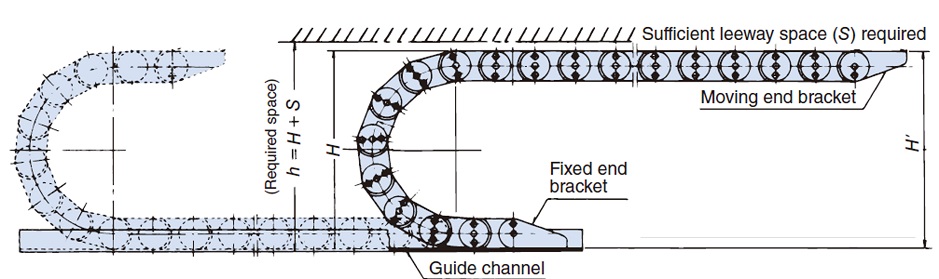
Note) Please design and install according to the installation height H' dimension.
 Learn more about the structure
Structure explanation (main body, bracket, mounting bracket, partition plate)

Cable Carrier (CABLEVEYOR) body
It consists of links and arms and is the part that stores cables and hoses.
It has the ability to bend in only one direction at a fixed radius. There are various types of arm opening and closing structures, such as an outer periphery opening and closing type and an inner periphery opening and closing type.
Outer periphery

Inner side
In the case of the inner and outer both-side opening and closing type, the inner arm is called the lock stay.
Brackets/Mounting hardware
This is a part used to attach Cable Carrier (CABLEVEYOR) to the device. If it is made of resin, it is called a bracket, and if it is made of metal, it is called a mounting bracket.
There are various types available, including structures and installation methods. The appropriate type varies depending on the size, so please check each product page for details.
Partition
This is a part used to divide the storage space inside Cable Carrier (CABLEVEYOR) body.
- Vertical divider: Divides the storage space inside Cable Carrier (CABLEVEYOR) body into left and right sections. There are sliding and fixed types, and they are usually installed every two links.
- - Horizontal divider: Divides the storage space inside Cable Carrier (CABLEVEYOR) body into upper and lower sections. There are two types: a system that divides the entire space into upper and lower sections, and a system that divides only a portion into upper and lower sections.
If you use a horizontal divider, you will need two or more vertical dividers. - ・The lineup of dividers varies by size. Please check each product page.
Cable Carrier (CABLEVEYOR) Product List
- Plastic Series
Open type - Plastic Series
Closed type - Clean Series
- Plastic Series
3D - Steel Series
Open type - Steel Series
Heavy load - Cable Carrier (CABLEVEYOR)
Accessories - TOTALTRAX
This type allows Cable Carrier (CABLEVEYOR) body to move in three dimensions.
It can be used for robots that operate in 3D.
If you are purchasing this product outside of Japan, please contact your nearest overseas office at the link below.
TKRB Series
Model number TKRB□□H□□~
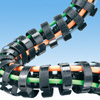
A 3D Cable Carrier (CABLEVEYOR) that can withstand large tension.
- - High tensile strength is achieved by the built-in wire.
- - The open structure makes it easy to handle.
- A wide range of accessories are available.
- - RoHS Directive compliant product
- - The length can be adjusted by cutting and connecting. Please refer to the instruction manual for details.
Variety
TKRB14H10~TKRB50H48
PMA Series
Model number PIS□~
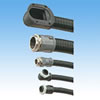
A hose-type Cable Carrier (CABLEVEYOR) that can move freely in three-dimensional space.
- - An integrated Cable Carrier (CABLEVEYOR) made by extrusion molding.
- - Eight sizes of main body and connectors are available.
- - Lengths up to 50m or 30m are available.
- - RoHS Directive compliant product
Variety
PIST-07B~PIST-17B
PISG-23B~PISG-48B
FTP Series
Model number FTP□□~
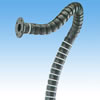
A closed-type 3D Cable Carrier (CABLEVEYOR) with a link structure.
- - The spherical structure of the link allows it to follow twists and rotations.
- - Tsubaki's unique simple closed structure.
- - You can create two-dimensional movements and straight lines.
- - RoHS Directive compliant product
Variety
FTP026R100