Product Info Large size conveyor chain
Large size conveyor chain can be freely combined to transport materials in any direction, including horizontal, vertical, and inclined orientations. They can withstand temperatures up to about 200°C without the need for special materials, and heat-resistant steel is used for higher temperatures. They also come in specifications that are corrosion-resistant and chemical-resistant to water and chemicals, making them suitable for a wide range of applications.
Almost any material can be transported, from powders such as pulverized coal and cement to granular materials such as wheat and soybeans, lumps such as ore and rocks, and even products weighing several tonnes each, and there are almost no restrictions on the materials that can be transported.

Table of contents
Large size conveyor chain related information
-
Selection
-
Materials
-
Operation

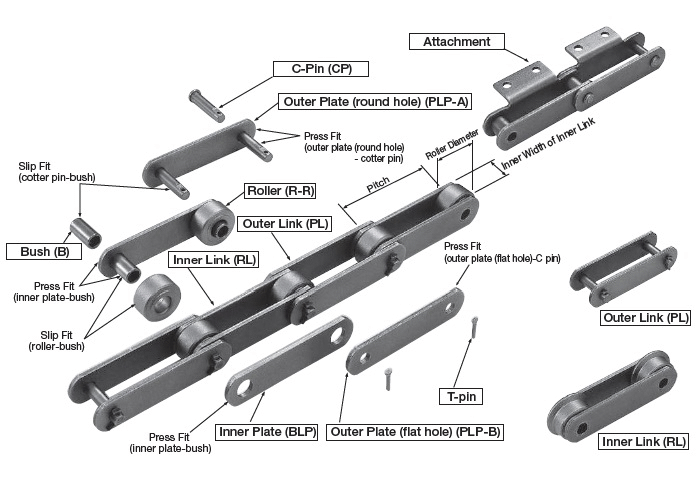
Structure
Screw Lock Link
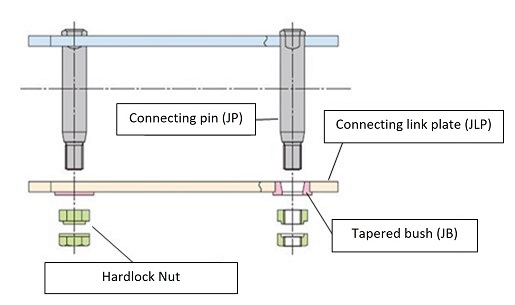
A connecting link that enables safe and fast work.
Note: Because this is a nut-type design, the pins are longer. Please check to make sure they do not interfere with the equipment.
*The overall length tolerance for Large size conveyor chain is ±0.25%.
■ Slip fit
A fit that always has a gap when the shaft and hole are combined.
A fit in which the tolerance area of the hole is entirely above the tolerance area of the shaft (pin or bush).
■ Press fit
A fit that always creates an interference when the shaft and hole are combined.
A fit in which the tolerance range of the hole is completely below the tolerance range of the shaft (pin or bush).
 Learn more about the components and their functions
| 1. Pin (CP) | 2. Bush (B) | |
|---|---|---|
| The most important role of pins is to connect outer link and Inner link. Like the plates, they receive chain tension in the direction of travel and reaction force from the transported goods in the perpendicular direction. Furthermore, when the chain articulate, the outer circumference of the pin slides against the inner circumference of the bushing, causing wear. Pins are an important strength component, but they also need to be wear-resistant. | The bushing is a strength component that receives the tension of the chain when it meshes with the sprocket, but its main function is as a bearing component. The outer circumference of the bushing wears out as it slides against the inner circumference of the roller when the roller rotates, and the inner circumference of the bushing wears out as it slides against the outer circumference of the pin when the chain articulate. Wear on the inner circumference of the bushing directly appears as pitch elongation. | |
| 3.Roller (RR, FR, SR, MR, NR) | 4. Plates (PLP-A, PLP-B, BLP) | |
| It has a slip fit with the bushing.. When it meshes with the sprocket, it acts as a roller, mitigating impact and wear on the tooth surface. It also rolls when traveling, reducing rolling resistance. | The plates are primarily subjected to tensile loads in the direction of chain travel, and to reaction forces at right angles to support the transported load. When the chain articulate, the outer and inner plates slide against each other, and when it engages with the sprocket, they slide against the side of the teeth. Generally, the outer plates have round or notched holes. | |
| 5. T-PIN | 6. Attachment | |
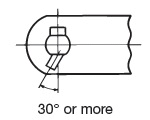 |
After press-fitting the pin into the outer plate, insert a T-pin and bend it to prevent the pin from falling out. Bend it by more than 30 degrees or until the end of the T-pin fits within the width of the plate. | This is the part that secures the attachment. For information on attachment types, see "Attachment Types" below. |
■The three basic dimensions of chains
Pitch, roller diameter, and inner link width are called the three basic dimensions of a roller chain. When these dimensions are the same, the roller chain and sprocket are dimensionally compatible.
Attachments are parts for attaching transport fixtures to chains. They can be installed at desired link intervals.
Standard Attachment
This is an economical and versatile attachment.
A attachment
It has a blade on one side.
They are called A1, A2, and A3 depending on the number of bolt holes.
A1 Attachment
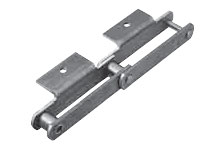
A2 attachment

A3 attachment
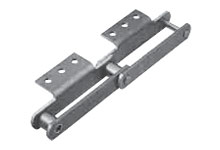
K attachment
This type has blades on both sides.
They are called K1, K2, and K3 depending on the number of bolt holes.
K1 Attachment
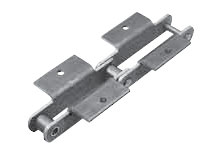
K2 Attachment
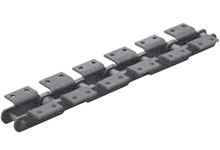
K3 Attachment

GA Attachment
This type has bolt holes on one side of the plate.
They are called GA2 and GA4 depending on the number of bolt holes.
GA2 attachment
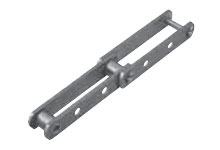
GA4 attachment
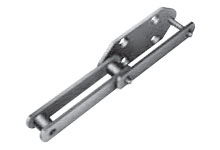
Dedicated attachment
Attachments for specific applications.
Deep Link
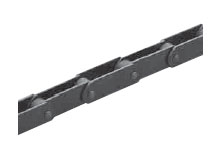
Top Roller
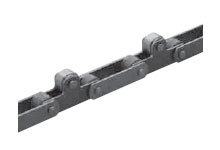
Outboard roller
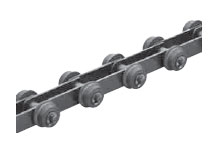
For flow
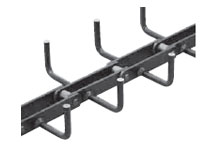
Special attachments (Plus α conveyor chain)
A variation of the special attachment.
With SA attachment
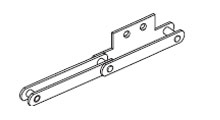
A type with a vertical blade on one side
SK attachment included
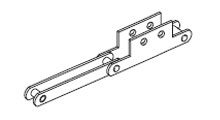
A type with vertical blades on both sides
CA2 attachment included
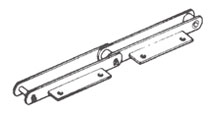
Net installation
For gap-free slat installation
AA3 attachment included
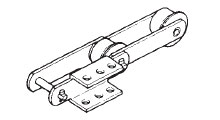
Powerful type that clamps attachments
AR2 attachment included
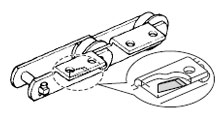
Improved bending rigidity of A attachment
(with reinforcing ribs)
MG2 attachment included
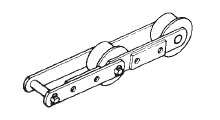
Can be used with one type of mounting jig
With AS2 attachment
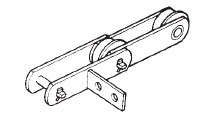
Scraper and flight mounting
AF2 attachment included

Deep scraper and flight mounting
WSA0 attachment included
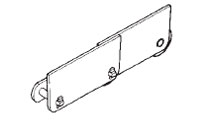
Prevents transported items from spilling
With extension pin
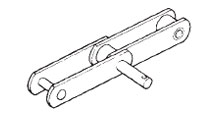
Can be attached to the end of a pin
(Format: EN)
With stay pin
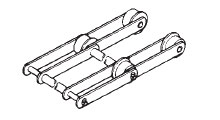
Directly mounted on connecting pin
Installation of nets, etc.
(Format: TN)
With top plate
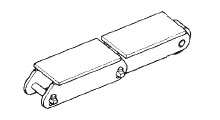
No scratches on transported items
(Format: TP)
With trolley roller
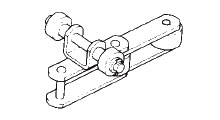
For horizontal long distances
(Format: TRO)
With outboard roller
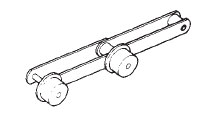
Supporting heavy loads
(Format: RO)
With guide shoe
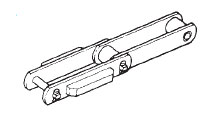
Prevents lateral vibration
(Format: GS)
With guide roller
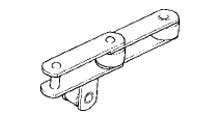
Horizontal use
(Format: GR)
With fixed dog

Push and transport
(Format: KD)
With dog roller
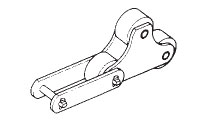
Pushing and transporting round objects
(Format: RD)
With tilting dog
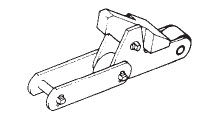
Conveyor storage
(Format: CD)
With roller tilting dog
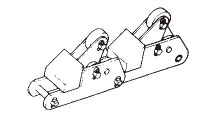
Round object storage
(Format: RCD)
With ducking dog
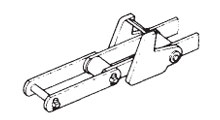
Leave the transported item in its designated position
(Format: DD)
Roller type
Large size conveyor chains come in three basic roller types depending on the application.
| Large size conveyor chain basic roller type | ||
|---|---|---|
| R Roller | F Roller | S, M, N roller |
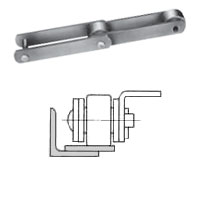 |
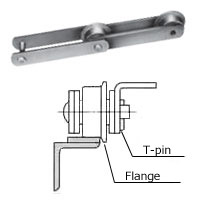 |
 |
|
|
It helps to reduce shock and wear when the sprockets engage.
|
Learn more about how to guide the rollers
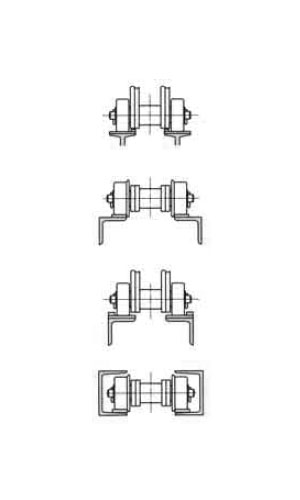
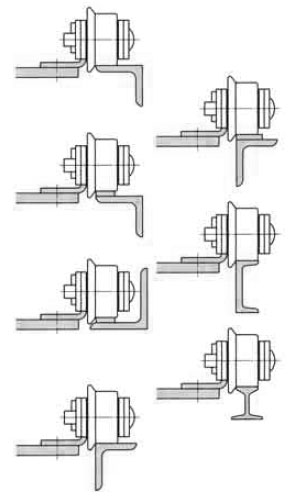
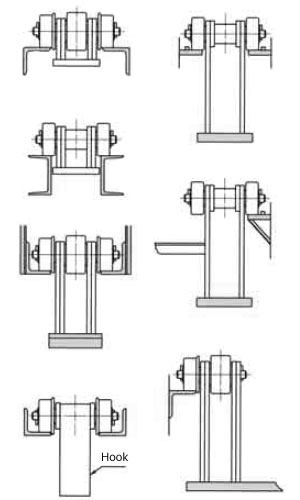
Below are examples of roller-type guide methods for the Carrying side and return-way to ensure smooth operation of Large size conveyor chain.
Guide method example
| R roller (S roller) type chain | F roller chain | Chain with outboard roller | |
|---|---|---|---|
| Carrying way | 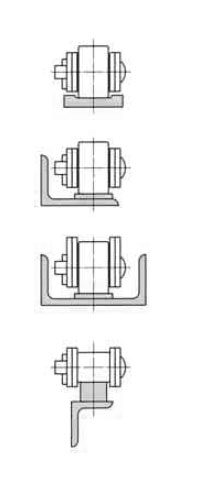 |
 |
 |
| Return-way | 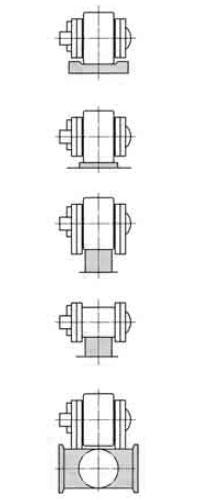 |
 |
 |
Safety Precautions
Never weld additional parts to an assembled chain, as this can cause the chain to bend or twist due to plate distortion and can also cause the parts to lose hardness or become brittle due to heat.
Large size conveyor chain product list
- General-Purpose & High-Power
- Environmental resistance
- Bearing Roller
Conveyor Chain - Specialized bulk item
- Function specialization
- Specialized in waste disposal
- Specializing in water treatment
- Applied Equipment
Accessories
Load capacity Large size conveyor chain (Bearing Roller Conveyor Chain)
Bearing Roller Conveyor Chain has a unique structure with cylindrical bearing inside the rollers, which reduces chain running resistance, significantly improves roller allowable load, and extends the wear life between the bushing and roller.
This achieves improvements that were difficult to achieve with conventional conveyor chains, such as "higher efficiency," "lower costs," "suppression of stick-slip phenomenon *," and "extended roller and rail life."
In addition to the standard specifications, we also offer dust-resistant specifications, Lube-free specifications, Water Resistant Lube Free Series, etc., so you can choose the model that best suits your needs.
*The chain repeatedly moves and stops even though the drive unit is operating continuously.
We also offer the convenient Screw Lock Link, which allows connection and disconnection with just a torque wrench.Learn more.
1. Bearing Roller Structure
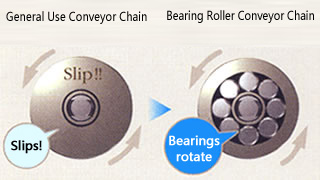
2. Function of bearing rollers
- - Reduced chain running resistance (1/3 of general-purpose products)
- - Significant increase in roller allowable load
3. Effect of bearing rollers
- -Reduction of chain tension and required power
- ・Prevents jerking during conveyor length and slow operation
- - Reduced roller rotation problems and rail wear
- - Improved wear life (between bushing and roller)
- ・Reduction of CO2 emissions and electricity bills
Bearing Roller Conveyor Chain Standard Series
Model number RF□□□□□BR・BF-DT・AT~
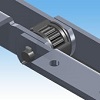
Our unique structure with cylindrical bearing inside the rollers allows for the smooth running of general-purpose conveyor chains (DT Series).
It has approximately 5 times longer wear life.
- - The motor power required can be reduced by approximately 1/3 and the chain size can be reduced by 2 sizes.
- -Contributes to reducing the cost of the entire facility.
- - The dimensions are the same as the R roller and F roller of RF conveyor chain.
- Ambient temperature: BR, BF: -20℃ to 80℃
Size
RF03 tons to RF36 tons
For inch sizes,
please contact us
Attachment Type
A1, A2, A3, K1, K2, K3
Roller type
BR roller, BF roller
Bearing roller conveyor chain Anti-Dust Series
Model number RF□□□□□DBR・DBF-DT・AT~
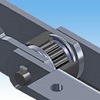
By using a labyrinth structure and seals, this conveyor chain is less susceptible to dust intrusion than standard Bearing Roller Conveyor Chain.
- - The labyrinth structure and seal make it difficult for dust to enter, and in dusty environments the wear life is three times longer than the standard specification.
- -There are two types of rollers: DBR and DBF.
- ・使用雰囲気温度:-10℃~80℃
Size
RF 10 tons to RF 36 tons
For inch sizes,
please contact us
Attachment Type
A1, A2, A3, K1, K2, K3
Roller type
DBR roller, DBF roller
Bearing Roller Conveyor Chain Standard Lube Free Series
Model number RF□□□□□EBR・EBF-DT・AT~

Special cylindrical bearing with self-lubricating properties are used between the bushing and roller, so the roller part
It can be used Lube-free, and no additional oil is required.
- -There are two types of rollers: EBR and EBF.
- ・使用雰囲気温度:-20℃~50℃
- *Please note that Maximum allowable load differs from that of the standard series. The allowable roller load is the same.
Size
RF03 tons to RF36 tons
For inch sizes,
please contact us
Attachment Type
A1, A2, A3, K1, K2, K3
Roller type
EBR roller, EBF roller
Bearing Roller Conveyor Chain Completely Lube Free Series
Model number RF□□□□□AEBR・AEBF-DT・AT~
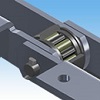
No additional oil is required between the pin and bushing or between the bushing and roller.
- - Steel rollers and special cylindrical bearing are installed alternately inside the roller.
Furthermore, by crimping and sealing a solid lubricant onto the inner surface of the bushing, no additional lubrication is required between the pin and bushing or between the bushing and roller. - -There are two types of rollers: AEBR and AEBF.
- Please note that Maximum allowable load differs from that of the standard series. The allowable roller load is the same.
- ・使用雰囲気温度:-20℃~50℃
Size
RF05 tons to RF26 tons
For inch sizes,
please contact us
Attachment Type
A1, A2, A3, K1, K2, K3
Roller type
AEBR roller, AEBF roller
Bearing Roller Conveyor Chain Water Resistant Lube Free Series
Model number RF□□□□□WEBR・WEBF-GS~
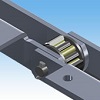
By alternately placing stainless steel rollers and special cylindrical bearing inside the roller, the roller can be used in an environment where it is constantly exposed to water, as it is water lubricated and does not require additional oiling.
- -There are two types of rollers: WEBR and WEBF.
- ・使用温度範囲:0℃~50℃
Size
RF03 tons to RF36 tons
For inch sizes,
please contact us
Attachment Type
A1, A2, A3, K1, K2, K3
Roller type
WEBR Roller, WEBF Roller