Product Info Drive chain
Drive chains are also called roller chains.
Drive chains are mechanical elements that transmit the power of a motor or other driver as tension to a driven shaft via gear-like rotating elements called sprockets.
It consists of five parts: an inner plate, an outer plate, a pin, a bushing, and a roller, and is generally used for low-speed, heavy-load power transmission and hanging drives.
It has excellent features such as a large reduction ratio, high flexibility in shaft distance, and double-sided use for multi-axis shaft transmission. It also has long life, high strength, and corrosion resistance, making it suitable for use in a variety of situations.

Table of contents
Drive chain Related Information

Drive chain transmission features
- ・A large reduction ratio can be achieved (generally up to 1:7).
- ・Long shaft distances (usually 4m or less) are possible. Another feature is the high degree of freedom in shaft distance.
- - Both sides of the chain can be used, allowing for multi-axis shaft transmission.
- - Easy to install and replace (easy to cut and connect)
- - If the chain is supported with a short shaft distance, it can be driven even if the shaft is vertical.
- - Compared to belt drive, the sprocket diameter can be smaller for the same torque.
- - Since force is transmitted through a large number of teeth, wear on the sprocket teeth is more advantageous than with gears.
- - It has a higher shock absorption capacity than gears.
Structure
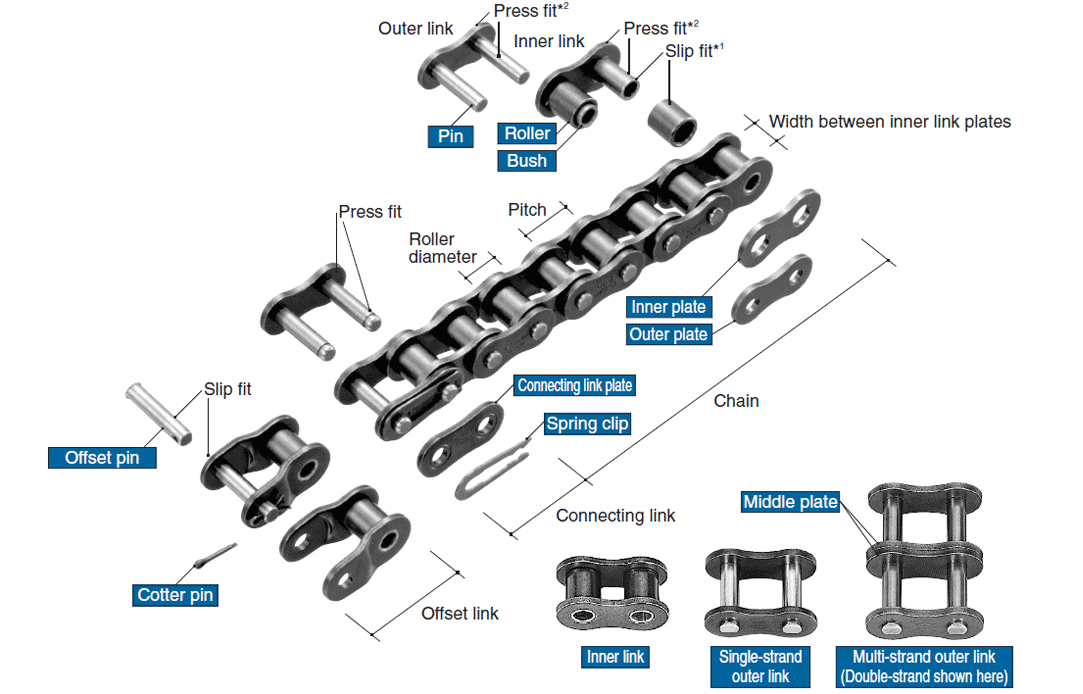
■The three basic dimensions of chains
Pitch, roller diameter, and inner link width are called the three basic dimensions of a roller chain. When these dimensions are the same, the roller chain and sprocket are dimensionally compatible.
*1 Slip fit
A fit that always has a gap when the shaft and hole are combined.
A fit in which the tolerance area of the hole is entirely above the tolerance area of the shaft (pin or bush).
*2 Press fit
A fit that always creates an interference when the shaft and hole are combined.
A fit in which the tolerance range of the hole is completely below the tolerance range of the shaft (pin or bush).
 Learn more about the components and their functions
Plate
Plates are members that bear the tension applied to the roller chain during power transmission. This tension is usually a repeated load, but can sometimes be accompanied by impact. Therefore, plates are required to have not only static tensile strength, but also high fatigue strength, impact strength, and dynamic toughness.
Pin
The pins are subjected to shear and bending forces through the plate, and at the same time, when the roller chain bends and meshes with the sprocket, they form the bearing together with the bushing. Therefore, they need to have shear strength, bending strength, toughness, and wear resistance.
Bush
The bushing receives complex forces through various parts, but in particular, when it engages with the sprocket, it receives repeated impact loads through the rollers, so it must have high impact fatigue strength.In addition, it must be wear-resistant because it acts as a bearing when mated with the pin.
Roller
When the roller chain engages with the sprocket, the roller is subjected to repeated impact loads due to collisions with the front teeth. In addition, after engaging, the equilibrium position of engagement with the teeth changes depending on the magnitude of tension, so the roller moves along the tooth surface while being pinched between the teeth and the bushing, and is subjected to compressive loads and frictional forces. Therefore, impact fatigue strength, compressive strength, and abrasion resistance are required.
Note: RS11-SS, 15, 25, and 35 do not come with rollers.
Inner link
Two bushings are press fit fitted into two inner plates, and rollers are fitted to the outside of the bushings so that they can rotate. The same design is used for both single- and multiple-strand chains.
Outer link and intermediate plate
Outer link has two pins press fit into two outer plates. In the case of multiple strand roller chain, an intermediate plate is added to outer link. The intermediate plate of RS roller chain is slip fit (*1), while that of Super chain is press fit (*2).
Learn more about connecting parts
Roller chains are usually made up of many connected links and are used either as endless chains or with the ends fixed, but in either case a connecting link is required (and special connecting links are used for hanging applications, etc.). Also, if a roller chain has an odd number of links, offset links can be used, but it is best to design it with an even number of links whenever possible.
Connecting Link

[Click to enlarge]
| Chain Type | Connecting link name | Between pin and connecting link plate |
Connecting link plate Fastening method |
Precautions |
|---|---|---|---|---|
| RS roller chain | M-type connecting link Model: JL |
Slip fit (M) |
Spring clip pin Cotter pin Spring pin |
For multiple strand connecting links, install connecting link plate with RC processing (Note 3) on the outermost side. The operating speed is within the range indicated by the white area on kW ratings table. |
| F-type connecting link* Model: FJL |
Press fit (F) |
Spring clip Cotter pin Spring pin T-pin |
Be sure to use the product for the specified purpose and within the speed ranges indicated in the colored sections of kW ratings table. If you require an F-type connecting link, please be sure to specify this when ordering. |
|
| Lambda Chain | M-type connecting link Model: JL |
Slip fit (M) |
Spring clip Cotter pin |
Can be used across the entire range of Lambda Chain kW ratings table. Connecting link plate is RC processed. |
| Super chain | M-type connecting link Model: MJL |
Slip fit (M) |
Spring pin | Connecting link plate is RC processed. |
| F-type connecting link Model: FJL |
Press fit (F) |
Spring pin | Use in harsh conditions such as transmissions with large impacts, especially transmissions with large loads or where side forces may be applied. | |
| Super-H chain Ultra Super chain |
F-type connecting link Model: JL |
Press fit (F) |
Spring pin | Please use the dedicated connecting links for each chain. |
| RS-HT chain | M-type connecting link Model: MJL |
Slip fit (M) |
Split pin Spring pin |
Connecting link plate is RC processed. Use the special connecting links for RS-HT chain. |
| F-type connecting link* Model: JL |
Press fit (F) |
Split pin Spring pin |
Use the special connecting links for RS-HT chain. | |
| Catalogue description Other roller chains |
M-type connecting link Model: JL |
Slip fit (M) |
Cotter pins and spring clip Spring pin T-pins and Z-pins |
Please refer to the dimension diagram for each chain. Please note that only NP, NEP and SNS chains have RC processed connecting link plate. |
| Note) | |
| 1. | Connecting link plate fastening style for each chain size is as shown in the dimension drawings and respective notes. |
| 2. | *Only the F-type connecting link plate for RS roller chain and RS-HT chain have a black exterior color. |
| 3. | Ring coin (RC) processing is a unique Tsubaki process that creates a plastically deformed area along the pin hole in the connecting link plate, with the aim of generating residual stress around the hole.Even with slip fit, there is no reduction in strength and the chain can be used with the same strength as the main chain. |
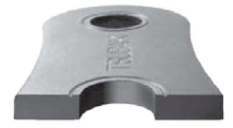
Ring coin processing
Offset Link

[Click to enlarge]
| Note) | |
| 1. | Please refer to the dimension drawing for the types and sizes of roller chains that can be used with offset links. |
| 2. | The transmission capacity and maximum allowable load of offset links may be lower than that of the main chain. |
Drive chain product list
- General-purpose Drive chain
- Lube-free Drive chain
- Heavy duty drive chain
- Environmentally resistant Drive chain
- Miniature Drive chain
(Miniature roller chain) - Special Chain
- Drive Chain Accessories
Tsubaki Heavy duty drive chain combines powerful transmission with compactness
This Heavy duty drive chain achieves excellent transmission capacity, allowable load, and tensile strength by increasing the plate shape and thickness.
Compared to RS roller chain it offers greater transmission capacity, allowable load, and tensile strength, and allows for a size reduction of 1-2 sizes.
With its wide range of products and high Maximum allowable load, it is widely used for compact and powerful power transmission and suspension applications.
Purpose
- - Harsh applications involving large impacts
- ・Facilities and machinery that require space saving
- - Applications requiring greater transmission capacity, allowable tension, and tensile strength
- - Applications requiring smaller elastic elongation (Examples: construction machinery, agricultural machinery, lifting machinery, port machinery, multi-story parking garages, etc.)
Different uses
| Item/Variety | Super chain | RS-HT chain | Super-H chain | Ultra Super chain |
|---|---|---|---|---|
| Main uses | For heavy-duty transmission/hanging | |||
| Features |
|
|
|
|
| Note) For powerful transmission at low and medium speeds, When using in a high speed range not listed in kW ratings table Please select RS roller chain. |
||||
| Main application |
Examples: Construction machinery, agricultural machinery, lifting machinery, port machinery, multi-story parking garages, etc. | |||
| Offset Link | single strand chain only, 4-pitch type Offset links are available. |
There is no offset link. Please use an even number of links. |
||
| Sprocket | Both single strand and multiple strand chains RS roller chain Sprockets can be used. |
|
||
|
||||
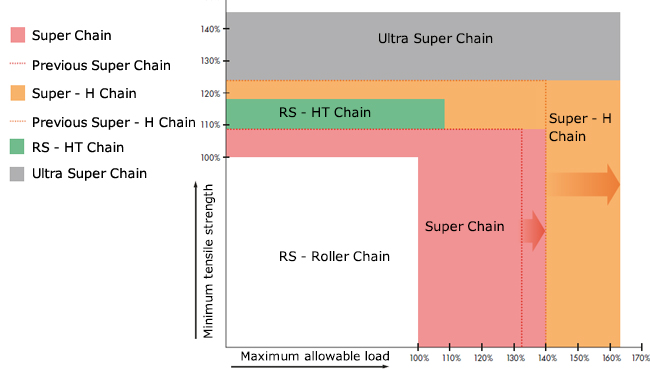
Comparison of minimum tensile strength and Maximum allowable load
RS roller chain minimum tensile strength and Maximum allowable load are assumed to be 100%
Super chain
Model number RS□□-SUP~

Approximately 40% higher allowable load than RS roller chain
- -High transmission capacity.
- - Fatigue strength is 40% higher than RS roller chain.
- -High impact absorption.
- RS roller chain can be reduced by one size.
- - For heavy-duty transmission at low and medium speeds. For high-speed use, please use RS roller chain.
Size
RS80~RS240
RS-HT chain
Model number RS□□-HT~

Approximately 20% higher tensile strength than RS roller chain
- -High tensile strength (19% higher than RS roller chain)
- - Ideal for low speed drives of 50m/min or less.
- -High transmission capacity.
- -High impact absorption.
- - When using at high speeds, please use RS roller chain.
Size
RS60~RS240
Super-H chain
Model number RS□□-SUPH~
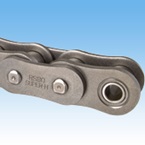
Super chain plate thickness increased by one size
- - High fatigue strength (16% higher than Super chain)
- -High tensile strength (13% higher than Super chain)
- -High impact absorption.
- - Maximum allowable load equivalent to that of a double-strand RS roller chain.
- -Has the highest Maximum allowable load of any Tsubaki Drive chain.
Size
RS80~RS240
Ultra Super chain
Model number RF□□-USN~

This chain has the highest tensile strength.
- - A roller chain with oval plate shape and plate thickness that is one size larger.
- · RS roller chain can be reduced by two sizes.
- - It has the highest fatigue strength.
- - It has the highest tensile strength and shock absorption.
Size
RF100~RF240