Product Info: Linear Actuator
Tsubaki's linear actuator include a lineup of electric cylinders and jacks that use high-quality screws manufactured in-house, as well as our proprietary Zip Chain Zip Chain Actuator.
Both the screw mechanism and Zip Chain mechanism make the most of the product's features and can be used for a wide range of applications, including high-speed, high-frequency operation and operation requiring high precision.
* Zip Chain mechanism is our proprietary technology in which two chains interlock like a zipper to form a single, strong pillar that can be used for both pushing and pulling.
Table of contents
Linear actuator related information
-
Selection
-
Materials
-
Operation


Linear motion mechanism type
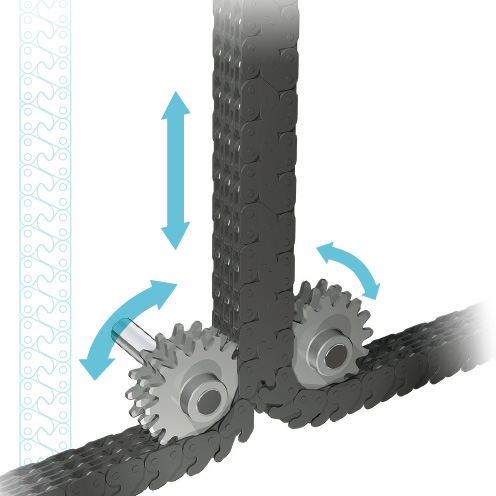
Zip Chain Mechanism
- High speed
- High frequency
- High durability
- Compact
This mechanism uses Tsubaki's proprietary technology, "Zip Chain."
It is highly compact and has the high speed, high frequency and durability required for high tact operation.
By interlocking two chains together to form one rod, it is possible to push and pull.
It was named Zip Chain because it interlocks like a zipper.
(Click here for the special website for the Zip Chain mechanism)
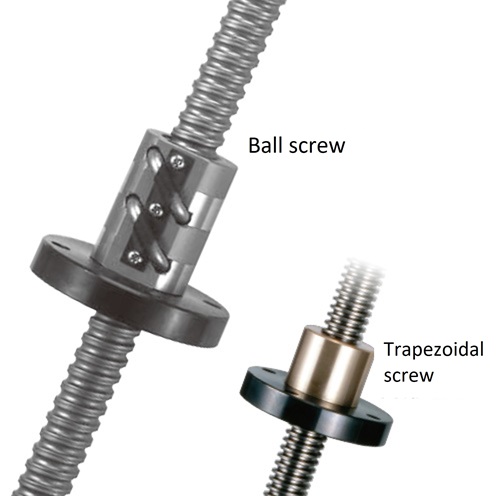
Ball screw mechanism/ Trapezoidal Screw mechanism
- High frequency
- Maximum allowable load
- Quietness
Ball screw mechanism
This mechanism uses steel balls placed between the screw shaft and nut to create rolling friction, allowing for highly efficient operation.
Compared to Trapezoidal Screw mechanisms, it is suitable for high-speed, high-frequency applications, making it suitable for assembly lines where productivity is required.
In addition, its high efficiency allows the drive source to be made smaller.
As we use highly reliable Ball screw manufactured in-house, it is possible to predict the running life.
Ball screw screw with a longer lead per rotation than a regular Ball screw is called a high-lead Ball screw, and can achieve higher speeds even with the same input rotation speed as a regular Ball screw.
Trapezoidal Screw mechanism
This mechanism works by the sliding friction between the screw shaft and nut, and is suitable for low-speed, low-frequency operation such as for maintenance purposes.
It has a self-locking property that Ball screw mechanisms do not have, making it possible to hold loads.
In addition, its simple structure makes it economical.
Tsubaki's linear actuator Product Line
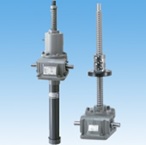
| Electric cylinder: Power Cylinder | Screw jack: Linipower Jack |
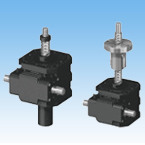
Ball screw lifting unit: Linispeed Jack |
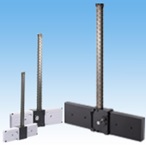
Interlocking chain actuator: Zip Chain Actuator |
||
|---|---|---|---|---|---|
 |
 |
 |
 |
||
| Mechanism Type | Ball screw Trapezoidal Screw |
Ball screw High Lead Ball screw |
Trapezoidal Screw | Ball screw | Zip Chain |
| The purpose | Pushing and pulling loads | Pushing and pulling loads | Load retention | Pushing and pulling loads | Pushing and pulling loads |
| Features | Motor integrated for easy wiring Realizing a clean environment |
Various screw types available | High Speed/High Frequency, Low Profile, Long Life | High speed and frequency that surpasses other mechanisms, Low profile, long life |
|
| Thrust | Max 490kN | 4.90kN~980kN | 1.96kN~980kN | 15kN~50kN | 400N~2000N |
| Stroke | Maximum 2000mm | Maximum 2000mm | Maximum 1500mm | Maximum 2000mm | |
| Speed and Operating Frequency | Maximum speed: 333mm/s Percentage duty cycle: 50%ED *1 |
Maximum screw shaft speed: 50 to 120 mm/s *2 Allowable Percentage duty cycle: 30%ED |
Maximum screw shaft speed: 40mm/s Allowable Percentage duty cycle: 20%ED |
Maximum screw shaft speed: 200mm/s Allowable Percentage duty cycle: 100%ED *3 |
最大速度:1000mm/s 負荷時間率:100%ED |
| Application example |
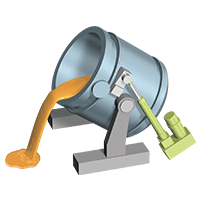
Tilting device 
Stopper |
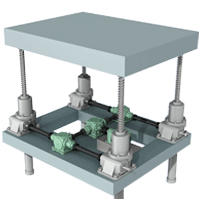
Table lift 
Rolling Mill |
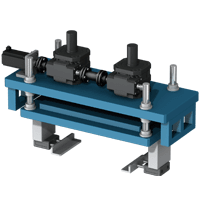
Traverser 's 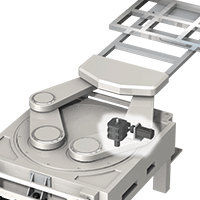
Take-out |
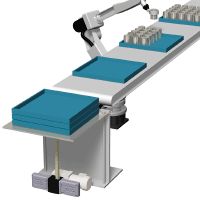
Stacking and unstacking 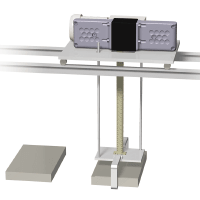
Pallet |
|
- *1 Eco series servo type
- *2 Varies depending on screw type
- *3 Varies depending on conditions.
Linear Actuator Product List
A screw jack consisting of Ball screw or Trapezoidal Screw and a worm gear.
A screw jack is a linear motion mechanism that converts the rotation of a driver into propulsion force using a screw and nut mechanism to move a screw shaft back and forth.
Unlike cylinders whose purpose is to push or pull a load, these cylinders are mainly used for holding a load, such as lifting/lowering and positioning objects to be transported.
Tsubaki's Linipower Jack has a mechanism that raises and lowers a screw using a built-in worm gear, and can be operated simply by connecting it to a drive motor.
It also supports linking multiple units using couplings and miter bevel gearboxes.
We also offer a variety of types and specifications, as shown below. We can provide Linipower Jack, which "meeting every specific need."
- ・Traveling nut type where the screw rotates and the nut raises and lowers, eliminating the need for pit installation
- - There are three types of screws: Ball screw (high speed, high frequency), high lead Ball screw (ultra-high speed, high frequency), and Trapezoidal Screw (low speed, load retention)
- ・Low dust emission specification ideal for clean rooms, stainless steel screw specification for screw shaft (Trapezoidal Screw only), left-handed screw specification for more freedom in layout (Trapezoidal Screw only)
JWB (Ball screw type)
Model number JWB~
The JWB (Ball screw type) is a screw jack that uses rolling friction to enable energy-saving operation.
- ・The main components are precision Ball screw and high-precision worm gears.
- ・High efficiency:
Ball screw provides high efficiency and produces a large thrust with a small drive source. - ・Higher speeds:
Compared to Trapezoidal Screw types, the increased efficiency of the screw allows for smoother operation at higher speeds. - ・Long life:
It uses a highly reliable Ball screw, ensuring a long life. - *It does not have a self-locking mechanism, so a brake is required.
Basic capacity kN
4.90~980
Screw type
Ball screw
Stroke mm
100~2000
JWH (High lead ball screw type)
Model number JWH~

The JWH (High lead ball screw type) is a screw jack that uses a high lead Ball screw, allowing it to achieve even higher speeds (up to 4 times faster) at the same input rotation speed as the JWB type.
- ・The main components are a high-lead Ball screw and a high-precision worm gear.
- ・High speed:
By using a highly reliable high-lead ball Ball screw, the screw shaft speed can be increased to a maximum of 7.5 m/min. - ・Low noise:
For the same speed as JWB (Ball screw type), a deceleration unit is used in the drive source to reduce the input rotation speed.
This allows for a quieter jack. - *It does not have a self-locking mechanism, so a brake is required.
Basic capacity kN
9.80~196
Screw type
High-lead Ball screw
Stroke mm
100~2000
JWM (Trapezoidal Screw type)
Model number JWM~
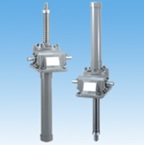
JWM (Trapezoidal Screw type) is a standard type screw jack suitable for low speed and low frequency use.
- ・The main components are the self-aligning Trapezoidal Screw and high-precision worm gears.
- ・Economical:
Simple and compact construction makes it economical. - ・Low speed/low frequency:
Taking advantage of the sliding contact Trapezoidal Screw characteristics, it is ideal for low speed, low frequency applications. - ・Load retention:
Trapezoidal Screw are calculated to have self-locking properties, and can be expected to retain load.
*Self-locking may become ineffective due to vibration, impact, etc. - ・Stainless steel screw specifications available:
For the two models, JWM025 and JWM050, the screw shaft is standardized with austenitic stainless steel. - ・Left-hand thread specifications available:
The input rotation direction is the same, but the screw moves in the opposite direction to the right-hand screw specification.
Basic capacity kN
1.96~980
Screw type
Trapezoidal Screw
Stroke mm
100~2000
Please also refer to the following documents for information on how to use each series.
Basic knowledge of screw jacks
Structure
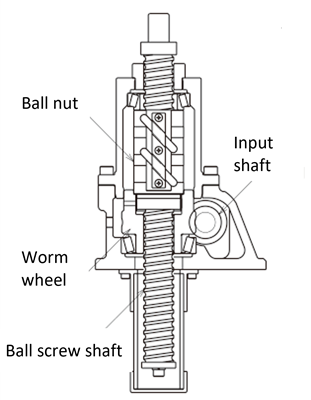
Ball screw type
Trapezoidal Screw type
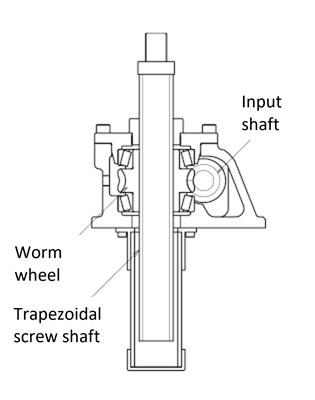
It mainly consists of the following elements.
- Input shaft:
A shaft connected to a drive source such as a motor usually has a worm gear attached to it. Torque is transmitted to the worm wheel via this worm. - Worm Wheel:
It receives torque from the worm and increases the torque while decelerating. - Nut:
It is integrated with the worm wheel, transmitting the torque amplified by the worm and worm wheel to the screw shaft (ball screw or trapezoidal thread). - Screw shaft:
The torque transmitted from the nut is converted into linear thrust through the threads.