| Q1 |
What are the service limits for each part of the conveyor chain? |
| A1 |
Generally, the lifespan of a conveyor chain is determined by the wear of each part. Which part will reach the end of its life first depends on the application.
The wear life limits of each part are as follows:
- (1) R Roller and F Roller
The limit is when the bottom surface of the plate begins to contact the rail due to wear on the contact surface and the sliding part with the bushing.
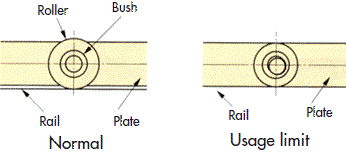
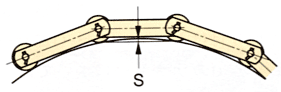
Furthermore, if the rail has a curved section, the wear allowance will be reduced by the dimension equivalent to S as shown in the diagram on the right, so even more care will be required compared to when the rail is flat.
- (2) S-roller
The limit is when the roller thickness has worn down to 60% and 40% remains.
- (3) Bush
The limit is when the bushing thickness has worn down to 60% and only 40% remains.
- (4) Plate
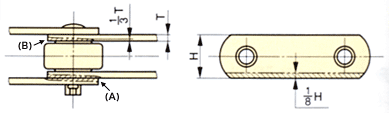
- Friction between plates and contact between the sides of the roller and the inside of the plate causes wear as shown in (A) and (B) in the diagram below (left). When the amount of wear exceeds 1/3 of the plate thickness, it reaches its limit.
- When the plate slides directly on the transported goods or on a rail, it wears across its width as shown in the diagram below (right). The limit is reached when this wear reaches 1/8 of the plate width.
- (5) Chain wear elongation
The chain bends when it engages with the sprocket or at the bend in the rail. This causes wear due to the sliding of the bushings and pins, which causes the chain to stretch in length.
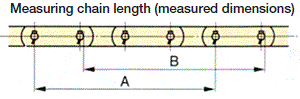
This usage limit is defined as the point at which the chain has elongated by 2% of the reference length (pitch x number of links). Measure as many links as possible (at least 4 links) as shown in the diagram below. Measure the chain length using either method A or B below, and compare it with the reference length to determine the chain's elongation rate (%).
- (A) Center to center of pins
- (B) From one end of the pin to the other end
Back to Questions
|
| Q2 |
How can the wear resistance of flow conveyor chain be improved? |
| A2 |
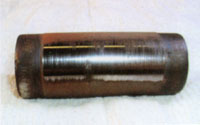
Flow conveyors used for transporting cement, etc., have traditionally offered BT Series, which improve the wear resistance of pins, bushings, and rollers through improved materials and heat treatment. However, when transporting highly abrasive materials such as fly ash (a cement raw material), even greater wear resistance is required, and in June 2000, we commercialized the FA specification flow conveyor chain for fly ash.
This is achieved by applying a special hardening treatment to the outer periphery of the bushings and rollers, which dramatically improves wear resistance.
[Comparison between BT Series and fly ash specification (FA specification)]
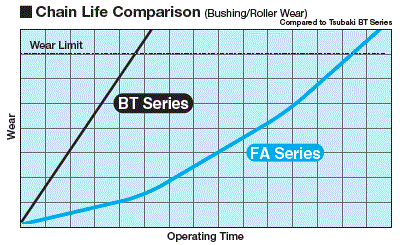
[Wear comparison]
■ BT Series
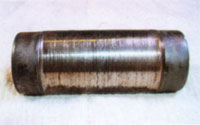
FA specifications
Back to Questions
|
| Q3 |
Why is Bearing Roller Conveyor Chain Economical? |
| A3 |
When comparing the prices of a general-purpose conveyor chain and Bearing Roller Conveyor Chain of the same size, Bearing Roller Conveyor Chain is more expensive. However, Bearing Roller Conveyor Chain have the following features, which result in cost reductions in the following areas and significant benefits in running costs.
- [Bearing Roller Features]
-
Low coefficient of friction
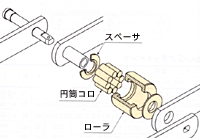
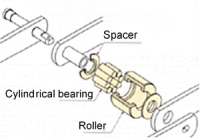
Bearing Roller Conveyor Chain have cylindrical rollers inserted between the bushings and rollers to create rolling contact. As a result, the coefficient of rolling friction of the rollers is 1/3 to 1/6 lower than that of general-purpose conveyor chains.
This reduces the tension on the chain to 1/3 to 1/6.
[Rolling friction coefficient (µ)]
- General-purpose conveyor chain
Without lubrication µ = 0.13 to 0.18, with lubrication µ = 0.08 to 0.12
- Bearing Roller Conveyor Chain
µ = 0.03
 [Click to enlarge]
-
High roller load capacity
allowable load of bearing rollers is approximately three times greater than that of general-purpose conveyor chains (R rollers).
For horizontal conveyance or conveyance on a slight gradient, the chain size is often determined by the roller's allowable load, so combined with feature 1, a smaller conveyor chain (size 2) can be used.
-
Easy maintenance and long life
Because it contains cylindrical bearing (bearings), lubrication times can be extended 5 to 10 times longer compared to general-purpose conveyor chains with ordinary sliding bearings, reducing the amount of maintenance required.
Furthermore, the wear life between the bushing and roller is significantly improved.
-
Less likely to jerk
There is little fluctuation in the roller's rolling friction coefficient, making jerking less likely to occur.
*For more information on jerking, please refer to "Q5. What are the causes and countermeasures for conveyor jerking?"
- [Cost benefits]
-

Back to Questions
|
| Q4 |
What precautions should be taken when temperatures exceed 400°C? |
| A4 |
Generally, when using chains in high temperature environments, the following problems arise:
- (1) Decrease in strength due to decrease in hardness
- (2) Increased elongation (risk of creep fracture)
- (3) Increased wear due to a decrease in hardness and an increase in the coefficient of friction
- (4) If the chain is being lubricated, the chain may bend poorly due to deterioration of the oil or carbonization.
For temperatures exceeding 400°C, stainless steel is used, and the chain is selected and designed according to the application, taking into consideration the issues mentioned above. Please consult us regarding use at temperatures above 400°C.
Back to Questions
|
| Q5 |
What causes conveyor jerking and what can be done about it? |
| A5 |
Jerking, also known as "surging" or "stick-slip," is a type of self-excited vibration, which refers to the phenomenon in which the chain repeatedly moves and stops even though the drive unit is operating continuously.
Generally, conveyor jerking is more likely to occur when the conveyor conveyor length is 10m or more and the chain speed is 15m/min or less.
The causes include the following:
- (1) Fluctuations in the coefficient of friction between the bush and roller
- (2) Insufficient chain rigidity
- (3) Insufficient rigidity of the drive unit and frame
The countermeasures are as follows:
- (1) Increase chain speed.
- (2) Divide the conveyor and shorten conveyor length.
- (3) Use a larger chain and strengthen the frame and guides to increase the rigidity of the conveyor itself.
- (4) Reduce and stabilize the coefficient of friction between the bushing and roller. There are two ways to do this:
- The chain is designed to be jerkless and is lubricated with Tsubaki jerkless oil.
- Uses Bearing Roller Conveyor Chain.
(However, if the chain speed is 2 m/min or less, please consult us.)
Back to Questions
|
| Q6 |
What should the take-up force of a conveyor chain be set to? |
| A6 |
It is preferable to leave an appropriate amount of slack under the drive unit to prevent the tension of the conveyor chain (take-up) from becoming too strong. However, in the following cases, it is necessary to take up the slack by taking up the chain.
- (1) Positioning on the conveyor
- (2) Frequent forward and reverse operation
- (3) The chain moves freely on the conveying side
Generally, it is sufficient to adjust the tension visually and by feel, but the numerical guidelines are as follows.
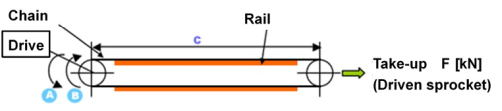
| [Calculation method] |
| Chain mass |
… M (kg/m) X N (条数) |
| Mass of slats and jigs attached to the chain |
… W (kg/m) |
| Amount of material being transported |
… m (kg/m) |
| · Center distance |
… C (m) |
Coefficient of friction between the chain (or fixture) and the rail
(Chain return-way (bottom)) |
… µ |
| · Gravitational acceleration |
… G ( = 9.80665m/s2) |
- Rotation direction A (forward rotation)
Take-up force: F ≧ { (MXN + W) XCX μ } XG/1000 X 2 X 1.2 to 1.5
- Rotation direction B (reverse rotation)
Take-up force: F ≧ { (MXN + W + m) XCX μ } XG/1000 X 2 X 1.2 to 1.5
If there is forward and reverse operation, adjust the take-up force in "Rotation direction B (reverse)".
[Note]
- The above F is a guideline for take-up. Adjust it while observing the conveyor's operating status.
- Make sure that the applied tension with the take-up force added does not exceed Maximum allowable load of the chain or fall below the appropriate safety factor.
- Overtensioning the chain will increase wear and shorten its lifespan.
Back to Questions
|
| Q7 |
How to guide the chain? |
| A7 |
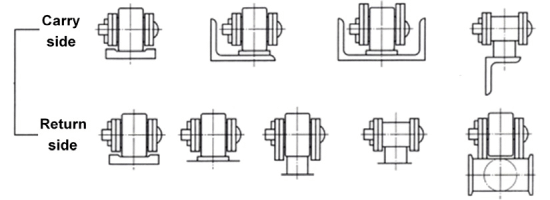
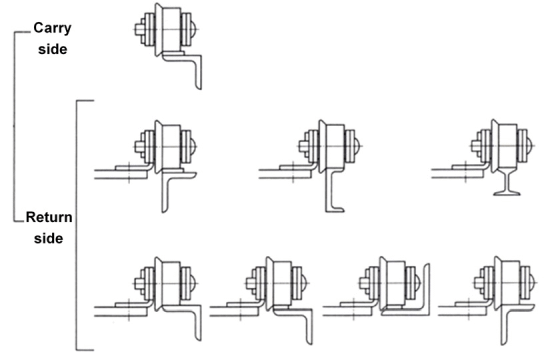
Below are some examples of chain guide methods. Please use them as reference for your design and concept.
- (1) bushed chain block chain
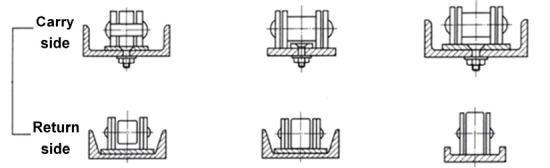
- (2) R roller and S roller type chains
- (3) F-roller chain
Back to Questions
|
| Q8 |
What is the operating temperature range for Screw Lock Link? |
| A8 |
The operating temperature range for Screw Lock Link is -20°C to 150°C. Please contact us if you intend to use them outside this temperature range.
Back to Questions
|
| Q9 |
What is the lifespan of a conveyor chain lubricator (TCL type)? |
| A9 |
The lifespan is determined by the following two points:
- (1) Main pump
When excessive use has made it impossible to properly lubricate.
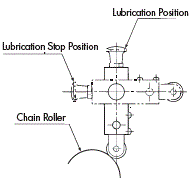
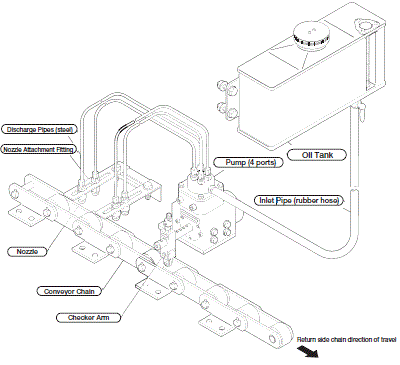
- (2) The checker arm is at the point where the tip roller has worn down and the checker arm body begins to interfere with the chain roller.
Usually, (2) will reach the end of its life first.
Replacement checker arms are available, so please replace the parts.
The rollers at the tips of the checker arms will wear out significantly faster if they are operated continuously. Once the required amount of oil has been added, stop the oil supply using the oil tank cock and make sure the checker arms do not come into contact with the chain as shown in the diagram on the right.
Also, please note that wear will progress significantly in an abrasive atmosphere such as dusty particles.
Back to Questions
|
| Q10 |
Can the conveyor chain lubricator (TCL type) be installed on an inclined conveyor? |
| A10 |
Installing the conveyor chain lubricator on an incline may result in poor oil discharge. Install the main unit of the conveyor chain lubricator on a horizontal surface.
Back to Questions
|