Q&A Power-Lock
We have posted frequently asked questions from customers in Q&A format. Please click on the question to proceed to the answer.
Words in Q&Aof
Consideration stage
Design edition
Surrounding Environment
Recruitment stage
Design edition
| Q20 | Can I use the TF series without a spacer? |
|---|
Handling
Use stage
Handling
Other

| Q1 | Can Power-Lock be used on a shaft that already has a keyway? |
|---|---|
| A1 |
Although the transmission torque and thrust load will be reduced to 90% of the catalog values, they can still be used. However, the EL series cannot be used on shafts with keyways, as they will become impossible to remove due to deformation of the main body. Back to Questions |
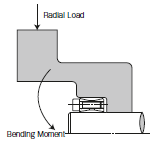
| Q2 | Can Power-Lock withstand bending moments? |
| A2 |
In principle, Power-Lock cannot withstand bending moments.
|
| Q3 | The shaft is short and Power-Lock protrudes slightly beyond the end of the shaft. Can I still use it? |
| A3 |
Because the shaft is short, uneven force is applied to the inner ring, etc., causing Power-Lock to deform, so it cannot be used.
|
| Q4 | What is the allowable limit for surface roughness of the shaft and boss that come into contact with Power-Lock? |
| A4 |
The values listed in the catalog below are the allowable limits, and rougher machining than these is not permitted. When surface pressure is generated on the shaft and boss surface, the pressure will crush any unevenness on the surface, causing plastic deformation of the shaft and boss.
|
| Q5 | I am thinking of using Power-Lock on a hollow shaft. Are there any problems? |
| A5 |
In the case of a hollow shaft, the shaft material and inner diameter must be considered to determine whether the hollow shaft is strong enough to withstand the pressure on the shaft side that is generated when Power-Lock is tightened. |
| Q6 | The catalogue includes a list of boss diameters, but the note states that "safety factors are not included." What is the safety factor? |
| A6 |
The minimum outer hub diameter dimensions that can withstand the surface pressure generated on the hub inner surface when the bolt is tightened with the specified tightening torque (MA) are listed in the catalog. The surface pressure generated varies depending on the tightening torque, so considering that the error of a typical torque wrench is about ±5%, a safety factor of 10% or more should be used. Back to Questions |
| Q7 | If a Power-Lock series without a centering function is used on a boss without a guide, what will be the centering accuracy? |
| A7 |
It is certain that the fluctuations will be extremely large, and the figures cannot be estimated or used.
|
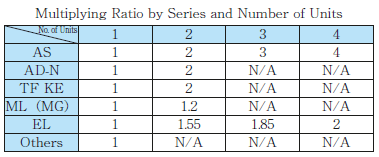
| Q8 | One Power-Lock does not provide enough torque, so I would like to use multiple Power-Locks in a row. What will the transmitted torque be in this case? |
| A8 |
The transmission torque increases, but the ratio varies depending on the series.
|
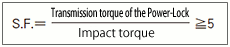
| Q9 | Can Power-Lock be used in applications where large impact loads are applied, such as presses and construction machinery? |
| A9 |
Even if repeated impact loads are applied, the product can be used satisfactorily as long as the safety factor is taken into consideration and the bolt tightening torque is properly controlled.
|
| Q10 | Power-Lock catalog states that "Power-Lock cannot, in principle, withstand bending moments," but what happens if a moment is actually applied? |
| A10 |
Power-Lock apply uniform surface pressure to the shaft and boss over the entire circumference to achieve frictional fastening. |
| Q11 | The KE series Power-Lock have a centering function, so hub bore can be straight, but the boss diameter table shows bosses with guides. Are there any cases where it is better to install a guide? |
| A11 |
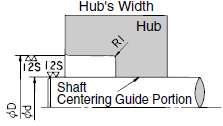
The main benefits of providing a guide section are the following three points. |
| Q12 | I am considering using the KE series, but outer hub diameter is not large enough. Is there any good solution? There is still torque capacity. |
| A12 |
Please consider the KE-LP series. Its Low Contact Pressure series allows for a smaller boss diameter. If this is still not enough, please contact us. Back to Questions |
| Q13 | The AS-SS instruction manual states that applying oil or grease will reduce transmission torque. Since lubrication is required and applying oil does not cause slippage, why does applying oil reduce transmission torque on SS Series? |
| A13 |
The coefficient of friction can be reduced by applying oil to both the standard lubrication-requiring type and the SUS lubrication-free type. |
| Q14 | For the AS series, how do you calculate the minimum required boss diameter when the boss width B is 2ℓ or less? |
| A14 |
If the boss width B is ℓ<B<2ℓ, calculate using hub geometry factor K3=1.0.
|
| Q15 | When selecting an AD-N without a guide, does hub length in the boss diameter table (2) need to be Lt or more? Is it okay if it is L or more? |
| A15 |
There is no functional problem even if it is L or larger, but the bolt head will protrude from the boss.
|
| Q16 | In the catalogue diagram of the AD-N mounted on a boss, there appears to be a gap between the PL and the boss. (Unless the boss hole is missing) Is there a need for a gap at the back of the hole? Will there be any problems if the PL is mounted against the back? |
| A16 |
There is no problem with placing Power-Lock against the back of the boss in the temporary assembly state. During installation, as the bolt is tightened, the tapered ring will move, creating a gap at the back of the hole. |
| Q17 | I have a question about the RE-SS series. Why is there a difference in the transmitted torque between with and without a retaining ring? |
| A17 |
The retaining ring acts as the flange of Power-Lock and prevents the boss from moving when fastening. |
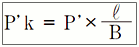
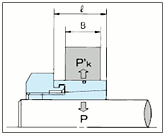
| Q18 | If the boss width is shorter than Power-Lock width, can it be used? |
| A18 |
Yes, the ML series can be used. However, since the surface pressure generated on the hub side will be large, it is necessary to calculate the hub side pressure P'k using the following formula and check that the hub material strength and required outer hub diameter are satisfied.
|
| Q19 | Can the EL series withstand radial loads? EL is not listed in the allowable surface pressure table in the selection section of the catalog. |
| A19 |
It can be used if Prad/P in the allowable surface pressure table is 10% or less. The shaft side pressure and boss side pressure will vary depending on the customer's specifications (bolt size, number, tightening torque, etc.). Back to Questions |
| Q20 | Can I use the TF series without a spacer? |
| A20 |
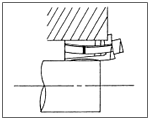
It cannot be used without a spacer for the following reasons. |
| Q21 | I installed Power-Lock at room temperature, but then I had to use it in a place with a temperature of about 180°C. The temperature difference is large, so will this cause problems such as a decrease in transmission torque? |
| A21 |
If the shaft and boss are made of the same steel type as Power-Lock, there will be no problem as the shaft, Power-Lock, and boss will expand as one unit. |
| Q22 | Can the stainless steel Power-Lock be used underwater? |
| A22 |
It can be used if a little rust does not cause any problems. Even when used underwater, the mounting contact surface has high surface pressure, so water hardly penetrates and there is no degradation of performance. |
| Q23 | Can I apply Raydent coating to Power-Lock? (For use in clean rooms) |
| A23 |
Raydent coating peels off, causing the tapered surface to become rough and reducing transmission torque.We recommend that you consider electroless nickel plating specifications (KE-KP, AS-KP, AD-N-KP, TF-KP) or stainless steel specifications (KE-SS, AS-SS, RE-SS). |
| Q24 | Are there any problems with using Power-Lock in an oil bath? |
| A24 |
There is no problem if you fill the oil after tightening the PL. However, if the oil or grease contains silicon-based or molybdenum-based antifriction agents or extreme pressure additives, please avoid reusing it. |
| Q25 | What happens if I assemble Power-Lock without using a torque wrench? |
| A25 |
The transmission torque and thrust load shown in the catalog are values when assembled correctly with the specified tightening torque. |
| Q26 | What happens if a bolt is tightened below the specified tightening torque? |
| A26 |
The tightening torque of the bolt and the transmission torque of Power-Lock have a proportional relationship. Therefore, if the tightening torque is reduced, the transmission torque will also be reduced accordingly, but it is not recommended to use the bolt with reduced tightening torque because it may cause the bolt to loosen. |
| Q27 | When installing, which parts should be oiled or greased? |
| A27 |
It must be applied to the contact surfaces of shafts and bosses, tapered rings, inner and outer rings, and other parts that come into contact with each other, as well as the seating surfaces and threaded surfaces of tightening bolts. |
| Q28 | What happens if a series that requires oil or grease to be applied to the tightening bolts is assembled in a dry state without applying oil or grease? |
| A28 |
If assembled without applying the oil, the transmission torque may decrease by 20% or more. Also, the tightening bolts may become loose due to vibration, etc. |
| Q29 | Is it okay to put a locking washer on the tightening bolt to prevent it from loosening? |
| A29 |
When Power-Lock is installed properly, there is no need to worry about the tightening bolts loosening. However, if a washer that generates a reaction force, such as a spring washer, is used, the tightening force will decrease, resulting in a decrease in axial force and a decrease in transmission torque, so it cannot be used. |
| Q30 | What should I be careful of when handling the AD-N series? |
| A30 |
Compared to other series, the AD-N series uses a smaller taper angle to ensure a large transmission torque. |
| Q31 | I am using the AD-N series Power-Lock. Please advise me on assembly methods, especially how to apply lubricant. |
| A31 |
Please refer to the video on our website that explains how to use the AD-N series Power-Lock. |
| Q32 | I am using Power-Lock TF series. Please tell me about its features and how to use it. |
| A32 |
Please refer to the video on our website that explains the features and handling of the TF Power-Lock series. |
| Q33 | I am using the EF Power-Lock series. Please tell me about its features and how to use it. |
| A33 |
Please refer to the video on our website that explains the features and operation of the EF Power-Lock series. |
| Q34 | How many times can Power-Lock be attached and removed? |
| A34 |
For models other than the AD-N series, this can be done about 10 times, provided that Power-Lock is not slipping and is not deformed or damaged. |
| Q35 | Can I reuse a slipped Power-Lock? |
| A35 |
Please disassemble the product completely and check that each part is not deformed or damaged. If there is no damage, you can reassemble it according to the instructions in Instruction Manuals and reuse it. |
| Q36 | Do Power-Lock bolts ever come loose? |
| A36 |
When a tightening bolt is properly tightened with the specified tightening torque (MA), the friction torque is greater than the torque that would cause it to loosen naturally, so there is no need to worry about it loosening. |
| Q37 | Is it best not to periodically check that Power-Lock 's tightening bolts are properly tightened with a torque wrench? Will doing so cause the bolts to break? |
| A37 |
There is no problem in checking the tightness. If you use a torque wrench to set it to the specified torque value and check it, it will not break unless it is rusted. |
| Q38 | Why is it necessary to apply grease to the threads when removing an AD-N series Power-Lock? |
| A38 |
This is to prevent seizure and galling of the threads. However, please avoid using lubricants that contain extreme pressure additives or molybdenum-based antifriction agents, as they will drastically change the coefficient of friction and may cause bolt damage. |
| Q39 | Can I purchase just the tightening bolts for Power-Lock? |
| A39 |
Please specify "Tightening bolts for Power-Lock model number" and ask your dealer for a quote for the required number. |
| Q40 | I am using Power-Lock "PL035X060", but the current model number is "PL035X060AS". Are there any differences? Also, can I just replace it with the new model? |
| A40 |
Power-Lock "PL035X060" and "PL035X060AS" are the same, with only the model number being changed. Although the dimensions remain the same, some specifications were revised in March 2012, with changes made to the tightening torque (some sizes only), transmission torque, thrust load, shaft side pressure, and boss side pressure. |
| Q41 | I am using Power-Lock "PL045X075AD," but the current model number is "PL045X075AD-N." Are there any differences? Also, can I just replace it with the new model? |
| A41 |
Power-Lock "PL045X075AD" and "PL045X075AD-N" are compatible in both capacity and dimensions, but have undergone minor changes. The internal mechanism has been improved from the previous AD type, making it easier to remove. Therefore, it is possible to replace the "AD" with the "AD-N." |