Troubleshooting Synchronous Belts and Belt Sprockets abnormalities and how to fix them

| 1 | Premature belt breakage |
|---|
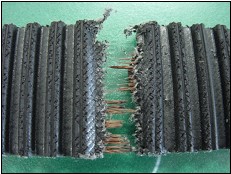
| Cause 1 | Overload | Solution | Check the inertia of the driven body, the prime mover, the conditions of use, etc. |
|---|---|---|---|
| Cause 2 | Shock Road | Solution | The belt will be increased in size and equipped with a shock absorbing mechanism. |
| Cause 3 | Belt bending | Solution | Take care when transporting, storing, and installing the belt. |
| Cause 4 | Pulley diameter is too small | Solution | The number of pulley teeth must be equal to or greater than the minimum allowable number of teeth. |
| 2 | Belt tooth wear |
|---|

| Cause 1 | Overload | Solution | Change the design. |
|---|---|---|---|
| Cause 2 | Excessive installation tension | Solution | Adjust installation tension. |
| Cause 3 | Insufficient installation tension | Solution | Adjust installation tension. |
| Cause 4 | Improper pulley tooth profile and dimensions | Solution | Replace the pulley with one that has the correct tooth profile and dimensions. |
| Cause 5 | Use in dusty atmospheres | Solution | Improve the atmosphere or put a cover on it. |
| 3 | Belt tooth skipping |
|---|
| Cause 1 | Shock Road | Solution | Size up your belt. |
|---|---|---|---|
| Cause 2 | Insufficient belt installation tension | Solution | Adjust installation tension appropriately. |
| Cause 3 | Insufficient number of meshing teeth | Solution | Increase the number of teeth on the pulley or increase the number of meshing teeth on the idler. |
| Cause 4 | Insufficient rigidity of the stand on which the belt is attached | Solution | Use a rigid stand. |
| 4 | Belt tooth shear failure |
|---|

| Cause 1 | Final stages of Phenomenon 2 and 3 | Solution | The same measures as for symptoms 2 and 3. |
|---|
| 5 | Belt side wear and tear |
|---|

| Cause 1 | Poor parallelism of the shaft | Solution | Correct the parallelism. |
|---|---|---|---|
| Cause 2 | Misaligned pulleys | Solution | Correct the alignment. |
| Cause 3 | Insufficient rigidity of the stand on which the belt is attached | Solution | Use a rigid stand. |
| Cause 4 | Flange bending | Solution | Replace with a good flange or repair. |
| 6 | Vertical scratches on the belt tooth surface |
|---|

| Cause 1 | Belt running over the edge of the pulley | Solution | Correct the alignment of pulleys and the parallelism of the shafts. |
|---|---|---|---|
| Cause 2 | Belt riding up onto flange | Solution | Apply proper installation tension. |
| 7 | Partial cut of belt |
|---|
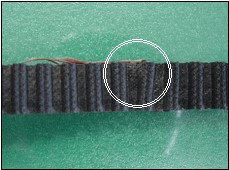
| Cause 1 | Foreign object caught | Solution | Improve the environment or provide a cover. |
|---|---|---|---|
| Cause 2 | Belt riding up onto flange | Solution | Adjust the belt installation tension appropriately and ensure accurate shaft parallelism. |
| 8 | Belt shrinkage |
|---|

| Cause 1 | Swelling due to oil or water | Solution | Improve the environment so that it is not exposed to oil or water, or install a cover. |
|---|
| 9 | Apparent belt elongation |
|---|
| Cause 1 | Axes move closer together | Solution | Mount the bearing firmly and use a stopper to prevent the bearing from moving if there is a lot of impact. |
|---|
| 10 | Rubber on the back of the belt is sticky or softened |
|---|
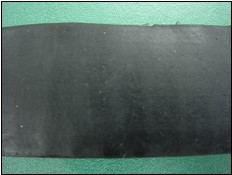
| Cause 1 | Back pressure idler slip | Solution | Adjust installation tension appropriately. Reduce the idler inertia. |
|---|---|---|---|
| Cause 2 | Oil adhesion | Solution | Improve the environment so that oil does not get on it, or put a cover on it. |
| Cause 3 | Use in high temperature environments | Solution | Lower the ambient temperature. |
| 11 | Wear of the rubber on the back of the belt |
|---|
| Cause 1 | Poor parallelism of the back pressure idler shaft | Solution | Correct the parallelism of the idler shaft. |
|---|---|---|---|
| Cause 2 | Rear pressure idler rotation failure | Solution | Improve the rotation of the idler. |
| 12 | Crack in the rubber on the back of the belt |
|---|

| Cause 1 | Pulley diameter is too small | Solution | Increase the pulley diameter. |
|---|---|---|---|
| Cause 2 | Use in low temperature atmosphere | Solution | Improve the ambient temperature. |
| 13 | Pulley tooth wear |
|---|
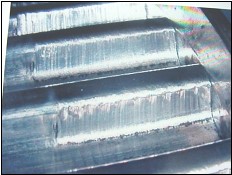
| Cause 1 | Inappropriate pulley material | Solution | The pulley is made wear-resistant by using a hard material, hardening the tooth surface, or by surface treatment. |
|---|---|---|---|
| Cause 2 | Use in dusty atmospheres | Solution | Improve the atmosphere or provide a cover. |
| Cause 3 | Excessive installation tension | Solution | Adjust installation tension. |
| 14 | Noise |
|---|
| Cause 1 | Excessive installation tension | Solution | Adjust installation tension appropriately. |
|---|---|---|---|
| Cause 2 | Overload | Solution | Size up your belt. |
| Cause 3 | Shaft parallelism and pulley alignment issues | Solution | Correct the parallelism of the shafts and alignment of the pulleys. |