Troubleshooting Top chain
If there is an abnormality in the chain, sprocket, etc., please first inspect it according to the catalog technical notes, installation and inspection.
Please check the location and symptoms of the abnormality and take the following measures.
Please check the location and symptoms of the abnormality and take the following measures.
Conveyor Equipment
| 1 | Abnormal noises: Squeaking, rattling |
|---|---|
| 2 | pulsation |
Chain
Conveyor peripherals and parts
| 9 | Wear debris accumulates along the rails and under the drive sprocket |
|---|---|
| 10 | Chain teeth skipping or poor meshing |
Transported goods
| 11 | Products tip over at conveyor transfer points, etc. |
|---|

Conveyor Equipment
| 1 | Abnormal noises: Squeaking, rattling |
|---|
| Cause 1 | The chain is hitting the safety cover, frame, etc.
|
countermeasure | Locate the source of the noise and correct it to prevent contact. |
|---|---|---|---|
| Cause 2 | The chain is running in an area where the rail guide clearance is narrow. | countermeasure | Identify the narrow areas and check for any thermal expansion or deformation of the rails and correct them. |
| Cause 3 | The rail surface is rough or the dimensions or material are inappropriate. | countermeasure | Replace rails with ones that have the appropriate surface finish, dimensional accuracy, and material. |
| Cause 4 | The chain moves in the opposite direction. | countermeasure | Redo the chain hem. |
| Cause 5 | Insufficient lubrication or excessive operating conditions. | countermeasure | Modify the lubricant and lubrication method. |
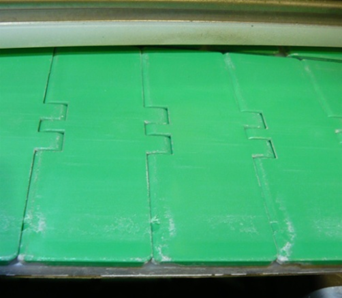

| 2 | pulsation |
|---|
| Cause 1 | The position and spacing of the return rollers and the position and size of the catenary curve are inappropriate.
|
countermeasure | Refer to the catalog technical notes and correct any improper parts to ensure a smooth return run. |
|---|---|---|---|
| Cause 2 | The idler roller or return roller does not rotate smoothly. | countermeasure | Measures are taken such as using bearings to make it easier to rotate smoothly and increasing the diameter. |
| Cause 3 | There are some places where the rail guide clearance is narrow. | countermeasure | Identify the narrow areas and check for any thermal expansion or deformation of the rails and correct them. |
| Cause 4 | Foreign matter adhering to the rails is hindering sliding. | countermeasure | Clean the rails by removing any foreign matter. |
| Cause 5 | The rail is caught on a sharp edge or an obstacle | countermeasure | Smoothing sharp edges and removing obstacles. |
| Cause 6 | Insufficient lubrication or excessive operating conditions. | countermeasure | Modify the lubricant and lubrication method. |

Chain
| 3 |


[Click to enlarge] |
Abnormal wear on the chain conveying surface |
|---|
| Cause 1 | The return roller is not rotating. | countermeasure | Increase the diameter of the return roller or change the specifications. |
|---|---|---|---|
| Cause 2 | The return entrance radius is too small or the diameter of the return roller is too small. | countermeasure | Refer to the catalog technical notes and make corrections. |
| Cause 3 | The surface finish of return-way rail is rough, or the placement or material is inappropriate. | countermeasure | Surface finish and rails of appropriate material should be arranged so that they contact evenly across the chain width. |
| Cause 4 | Roughness that promotes friction adheres to the return rollers and rails. | countermeasure | Clean the conveyor. Identify the cause and take measures. |
| Cause 5 | Guide channel or obstacles are damaged. | countermeasure | Identify and correct obstacles. |
| 4 | Abnormal wear or scratches on the backside of the chain |
|---|
| Cause 1 | Foreign matter is stuck or buried on the conveying rail, causing scratches on the chain. | countermeasure | Remove any foreign matter and clean. |
|---|---|---|---|
| Cause 2 | The surface finish of the rail on the transport side is rough. | countermeasure | Correct the surface finish or replace with a suitable rail. |
| Cause 3 | Contact marks with the idler wheel. | countermeasure | Replace the sprocket if necessary. |
| 5 | Abnormal wear on the side of the chain |
|---|
| Cause 1 | The rail or sprocket is not in the correct position. | countermeasure | Correct the position. |
|---|---|---|---|
| Cause 2 | The surface finish of the curved Plastic rail is rough or the material is inappropriate. | countermeasure | Replace the rail with one that has an appropriate surface finish and material. |
| Cause 3 | Insufficient lubrication or excessively harsh curve conditions. | countermeasure | Correct the lubrication method, etc. |
| 6 | The chain is stiff to bend |
|---|
| Cause 1 | Pins and links are bent or galled due to overload. | countermeasure | Remove the stiff spot or replace with a new chain. |
|---|
| 7 | Chain breakage or damage |
|---|
| Cause 1 | A foreign object or obstacle has been caught. | countermeasure | Remove any foreign objects or obstacles. |
|---|---|---|---|
| Cause 2 | Brittle fracture due to deterioration and corrosion caused by chemicals and high temperatures. | countermeasure | Identify the cause and change the conditions of use or change the chain specifications. |
| Cause 3 | The chain has climbed over the sprocket. | countermeasure | Replace the chain as it is caused by wear and elongation of the chain. |
| Cause 4 | The conditions of use were severe and an excessive amount of tension was applied. | countermeasure | Identify the cause and take measures. |
| Cause 5 | The plug has fallen off. | countermeasure | Check the condition of the plug. Replace it with a new one. |
| 8 | Chain discoloration |
|---|
| Cause 1 | Dirt is attached. | countermeasure | Wash. |
|---|---|---|---|
| Cause 2 | Deterioration caused by chemicals, high temperatures, ultraviolet rays, etc. | countermeasure | Check the conditions of use and replace the chain with one that meets the appropriate specifications. |
Conveyor peripherals and parts
| 9 | Wear debris accumulates along the rails and under the drive sprocket |
|---|
| Cause 1 | The surface finish of curved Plastic rail and other parts is rough. | countermeasure | Change the material grade of the curved Plastic rail. |
|---|---|---|---|
| Cause 2 | Sharp edges or obstacles on the rail end are scraping the chain. | countermeasure | Smooth the edges. |
| Cause 3 | Insufficient lubrication. | countermeasure | Provide adequate lubrication. |
| Cause 4 | Presence of roughness. | countermeasure | Identify the cause and take measures. |
| 10 | Chain teeth skipping or poor meshing |
|---|
| Cause 1 | The chain is overstretched. | countermeasure | Replace the chain and sprockets. |
|---|---|---|---|
| Cause 2 | Foreign matter has accumulated on tooth root. | countermeasure | Remove any foreign matter and clean. |
| Cause 3 | The sprocket is out of position. | countermeasure | Redo the installation. |
| Cause 4 | Inappropriate sprocket (damaged, deformed, swollen, corroded). | countermeasure | Investigate the cause, recheck the specifications, and replace if necessary. |
| Cause 5 | Damage to the area around the hub of a split sprocket. | countermeasure | Check for loose or over-tightened sprocket bolts. When replacing, check that the bolts are tightened to the correct torque. |
Transported goods
| 11 | Products tip over at conveyor transfer points, etc. |
|---|
| Cause 1 | Position and shape of guide channel, chain level, speed ratio, lack of slippage. | countermeasure | Make the guide angle gentler. Change the guide position. Adjust the speed and lubrication. Check the level. Make changes as necessary. |
|---|