Troubleshooting Roller Chain Drive Troubleshooting
General
Plate related
| 10 | Plate breaks |
|---|---|
| 11 | Cracks appear in the plate (fatigue) (perpendicular to the tensile direction) |
| 12 | Plate hole deformation |
| 13 | Stress corrosion cracking (bow-shaped cracks in the plate) |
Pin Related
| 14 | The pin breaks |
|---|---|
| 15 | Pin rotation or jumping out |
| 16 | Wear and rust occur only on the coupling pin when connected to metal fittings (hanging, etc.) |
Bush and roller related
| 17 | Roller bushing cracks (falls off) |
|---|---|
| 18 | The roller does not rotate |
| 19 | The roller opens |
| 20 | The roller becomes drum-shaped |

General
| 1 |
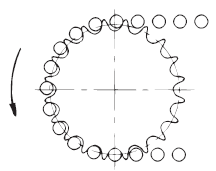 [Click to enlarge] |
The roller chain rides up onto the sprocket |
|---|
| Cause 1 | Roller chain and sprocket are incompatible | Solution | Replace the roller chain or sprocket with the correct size. |
|---|---|---|---|
| Cause 2 | Significant overload | Solution | Reduce the load (by oiling the driven machine, etc.), or increase the size or No. of strands of the roller chain, or increase the size. |
| Cause 3 | Roller chain wear and elongation or sprocket tooth wear | Solution | Replace with a new one. |
| 2 | There is an abnormal noise |
|---|
| Cause 1 | Improper installation of sprockets or shafts | Solution | Check and correct. |
|---|---|---|---|
| Cause 2 | Loose chain casing or bearings | Solution | Retighten all bolts and nuts. |
| Cause 3 | Roller chain slack is too much or too little | Solution | Adjust the center distance to obtain the optimum slack. |
| Cause 4 | Significant wear on the roller chain or sprocket | Solution | Replace a set of roller chain sprockets with new ones. |
| Cause 5 | Lube-free or improper oil supply | Solution | Fill with oil according to the conditions of use. |
| 3 | Roller chain vibrates |
|---|
| Cause 1 |
The roller chain resonates with the period of the external force.
|
Solution |
Change the vibration mode of the roller chain. 1. How to prevent resonance a. Changing the natural frequency of the roller chain. By applying or changing the initial tension, the effective tension is changed. ○Attach a tensioner and change the chain span. ○ Change the roller chain (change the mass and spring constant). b. Change the excitation frequency. ○Change the rotation speed of the sprocket. ○Review the equipment. 2. Reduce vibration mechanically. ○Attach a vibration stopper (guide stopper). ○Attach an automatic adjusting tensioner to the slack side.
|
|---|---|---|---|
| Cause 2 | The load fluctuation is abnormally large | Solution | Fluctuations can be reduced by using fluid couplings, etc. |
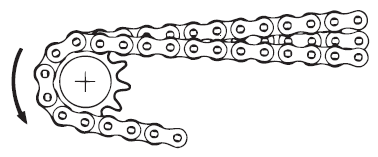

| 4 |
 [Click to enlarge] |
The roller chain gets wrapped around the sprocket (poor meshing). |
|---|
| Cause 1 | The axle distance is too long | Solution | Put an idler in the middle. |
|---|---|---|---|
| Cause 2 | Roller chain slack is excessive | Solution | Adjust the chain length or center distance. Attach the tensioner. |
| Cause 3 | Roller chain wear and elongation or sprocket wear | Solution | Both will be replaced with new ones. |
| 5 | Rust on roller chains |
|---|
| Cause 1 | Improper lubrication, bad atmosphere | Solution | After replacing the roller chain, protect it from the atmosphere by oiling and casing it. |
|---|
| 6 | Wear on the inside of roller chain plates and sprocket tooth sides |
|---|
| Cause 1 |
Poor installation
|
Solution | Correct the installation of sprockets, shafts, etc. |
|---|

| 7 | Wear on the side of the roller chain plate or pin head |
|---|
| Cause 1 |
Improper installation of guides, etc.
|
Solution | Check the condition of the guide and increase the gap between the guide and the roller chain. |
|---|
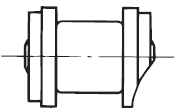
| 8 |
 [Click to enlarge] |
Roller chain bending is poor |
|---|
| Cause 1 | Roller chain deformation due to improper installation | Solution | Inspect and correct the installation condition. |
|---|---|---|---|
| Cause 2 | Wear debris and dirt buildup due to improper lubrication (e.g. grease) | Solution | Remove the roller chain, clean it and properly oil it. |
| Cause 3 | Significant overload, bent pin, cracked bush | Solution | Reduce the load or increase the roller chain size or No. of strands. |
| Cause 4 | Corrosion and rust | Solution | A casing is attached to protect the roller chain. |
| Cause 5 | Seizure due to improper oil supply | Solution | Apply lubrication appropriate to the conditions of use. |
| Cause 6 |
Pin and bush seizure
High speed operation can cause pins and bushings to seize, leading to poor bending and even breakage. |
Solution | Ensure that the conditions of use are appropriate. |

| 9 | Expansion of the inner width of the plate |
|---|
| Cause 1 |
Uneven load or significant overload due to improper installation
|
Solution | Replace with a new one and correct the installation. |
|---|

Plate related
| 10 | Plate breaks |
 [Click to enlarge] ①Static destruction When a load exceeding its tensile strength is applied, the plate will stretch and then break. |
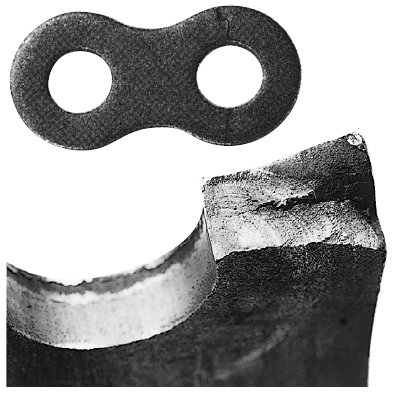 [Click to enlarge] ②Fatigue fracture A load exceeding the fatigue limit is applied, causing fatigue from the inside of the hole and rapid failure along the way. |
 [Click to enlarge] 3) Fatigue of the offset plate Because offset plates are bent in the center, stress concentration at the bend can cause fatigue failure. Therefore, offset links should be avoided whenever possible. |
|---|
| Cause 1 | Excessive shock load | Solution | Reduce the impact load by making the start and stop smoother (by installing a shock absorber, etc.). Increase the size of the roller chain or No. of strands. |
|---|---|---|---|
| Cause 2 | Roller chain vibration | Solution | Install devices to prevent vibration (tensioners, idlers, etc.). (See the section on roller chain vibration) |
| Cause 3 | Large inertia of driven machine (overload) | Solution | Reselect the roller chain (increase the size of the roller chain or increase No. of strands). |
| Cause 4 | corrosion | Solution | Replace with a new one. Protect the roller chain by attaching a casing. Also, clean and oil the roller chain regularly. |
| 11 | Cracks appear in the plate (fatigue) (perpendicular to the tensile direction) |
|---|
| Cause 1 | A load greater than Maximum allowable load is applied | Solution | Avoid excessive loads and excessive repeated loads, or increase the size or No. of strands of the roller chain. |
|---|
| 12 |
 [Click to enlarge] |
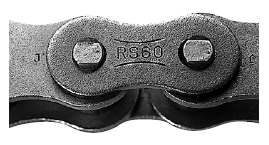
Plate hole deformation |
|---|
| Cause 1 | overload | Solution | Replace with a new one. Eliminate the cause of overload. |
|---|
| 13 |
 [Click to enlarge] |
Stress corrosion cracking (bow-shaped cracks in the plate) |
|---|
| Cause 1 | Use in acidic or alkaline environments (This is not due to the effect of repeated loading.) |
Solution | Replace with a new one. Protect the roller chain from the atmosphere by using a casing or similar. Consider specifications that are highly resistant to stress corrosion cracking. (Please consult with us.) |
|---|
Pin Related
| 14 | The pin breaks |
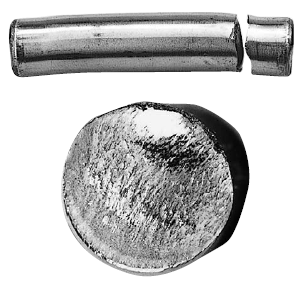 [Click to enlarge] ①Static destruction How roller chains break when tested for tensile strength |
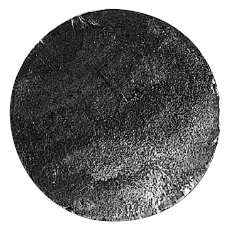 [Click to enlarge] ②Fatigue fracture The pin was repeatedly subjected to a large load that exceeded its fatigue limit, causing fatigue failure. The magnitude of the peak load was rechecked and measures taken. |
 [Click to enlarge] 3) Bending fracture due to shock The pin is broken by bending due to impact. A tensile load is applied to the side where the starting point is located, and the fracture progresses from the starting point. This type of phenomenon is particularly likely to occur if the pin surface is corroded, as it becomes weak against bending. |
|---|
| Cause 1 | Large impact load | Solution | Reduces shock and makes starting and stopping smoother. |
|---|---|---|---|
| Cause 2 | Repeated load exceeding the pin's fatigue limit | Solution | Avoid excessive repeated loads, or increase the size or No. of strands of the roller chain. |
| Cause 3 | corrosion | Solution | Attach the casing. Clean and oil the roller chain regularly. |
| 15 |
 [Click to enlarge] |
Plate hole deformation |
|---|
| Cause 1 | Overloaded or under-lubricated | Solution | Replace with a new one. Check for overload or improve oil supply. |
|---|---|---|---|
| Cause 2 | When the load is high and the lubrication is insufficient, an abnormal friction force occurs between the pin and bushing, which can cause the pin to turn instantly. If the chain is operated in this condition, the pin will come out and the roller chain will be destroyed. | Solution | Immediately replace with a new one. Do not weld the pin or reuse the old pin. (Discard the old roller chain to prevent it from being reused by mistake.) Also, if the pin head or plate side is worn, check the installation condition. |
| 16 | Wear and rust occur only on the coupling pin when connected to metal fittings (hanging, etc.) |
|---|
| Cause 1 | Improper initial oil supply during installation | Solution | Replace the connecting link. If the pins are significantly worn, replace the roller chain as well. When installing, pay particular attention to the connection of End fixture, such as those for hanging. |
|---|
Bush and roller related
| 17 | Roller bushing cracks (falls off) |
 [Click to enlarge] |
Fatigue failure This occurs when fatigue progresses during operation and the sprocket teeth are struck with a force greater than the transmission capacity. |
|---|
| Cause 1 | Excessive rotation speed or load | Solution | Reselect using kW ratings table. |
|---|---|---|---|
| Cause 2 | Improper lubrication | Solution | Apply oil appropriately to the conditions of use. Replace with new oil. |
| 18 | The roller does not rotate |
|---|
| Cause 1 | RS11-SS-1、RS15-1、RS25-1、RS35-1 | Solution | bushed chain and has no rollers. |
|---|---|---|---|
| Cause 2 | The inner plate is leaning inward or the bushing is cracked | Solution | Replace with a new one. Re-inspect the installation and check the load. |
| Cause 3 | Transported material or foreign matter gets between the bush and roller. | Solution | Remove the roller chain periodically. Protect it by installing a casing. |
| 19 | The roller opens |
|---|
| Cause 1 |
overload
|
Solution | Reduce the load. Properly lubricate. |
|---|

| 20 | The roller becomes drum-shaped |
|---|
| Cause 1 | Overload or insufficient oil | Solution | Replace with a new one. Check for overload or improve oil supply. |
|---|