technical data Large size conveyor chain Selection
2. Deciding on the conveyor type
| Conveyor basic type | Transported goods | |||
|---|---|---|---|---|
| countable item | Chain type | bulk item | Chain type | |
| Type of loading of transported goods | ・Slat conveyor
|
RF- [BR/BF] RF-(NB) RF RF-[DBR/DBF] |
・Apron/pan conveyor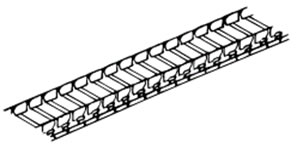
|
RF RF-(KG/KA) |
| ・Pusher conveyor ・Tow conveyor roller coaster 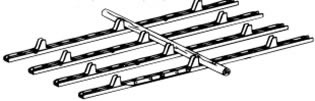
|
RF RF-(NB) NF RF-<SR> |
|||
・Free flow conveyor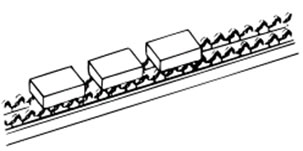
|
RF-[VR] RF-<SR> RF-<TR> |
|||
・Plain chain conveyor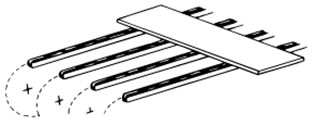
|
RF NF RF-(DL) |
|||
| A type in which the transported item is suspended | ・Trolley conveyor | RF RF-<TRO> |
・Bucket elevator | RF B |
・Tray elevator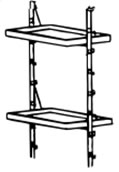
|
RF NF |
・Fly ash bucket elevator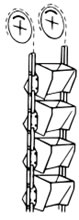
|
RF-(FB) | |
・Multi-story parking machine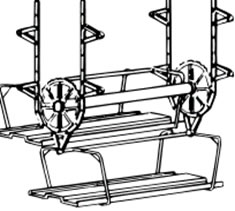
|
RF Dedicated chain |
・Bucket type continuous unloader | Special Chain | |
| A type that moves conveyed items by pushing or friction | ・Pusher conveyor
|
RF NF RF-(NB) |
・Scraper/flight conveyor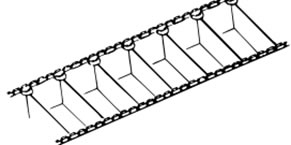
|
RF RF-(AM/AP) RF-(FG/FP) |
・Horizontal circulation conveyor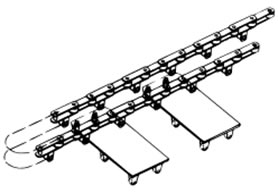
|
RF RF-(NB) RF-<GR> |
・Flow conveyor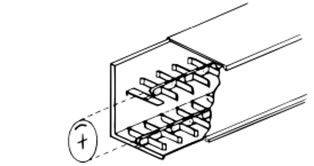
|
RF NFX |
|
| ・Drag chain conveyor | WD | |||
Note)
- 1. For the abrasion and corrosion characteristics of the transported items, please refer to the corrosion resistance against various solvents.
- 2. () indicates the specification code, [] indicates the roller type, and <> indicates the dedicated attachment type.
3. Deciding on the chain format
When deciding on the chain type, we first determine the transport method after understanding the properties of the transported items, and then select the most economical chain conveyor type for that purpose.
Conveyor chains can be used in the three basic formats shown in the table above, as well as other formats. Refer to the previous page to determine the chain format that best suits your application.
| Points to note when deciding on chain format |
|---|
|
4. Deciding on the roller type
Please refer to "Roller Types" in Large size conveyor chain Structure section.
5. Basic layout of conveyor chain
5.1 Horizontal transport
A catenary on return-way (bottom of the diagram) can absorb expansion and contraction caused by heat and other factors. It can be used at relatively low speeds, and the appropriate amount of sagging is usually about 10% of the span. It is difficult to use on conveyors with reversing motion.
1) On the outer side of the drive sprocket Catenary How to make
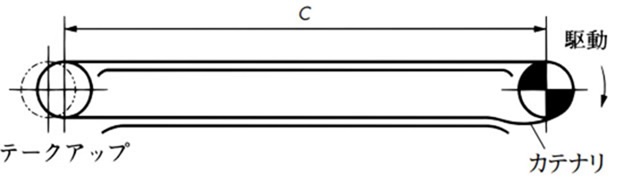
advantage
- 1) Catenary tension smooths the engagement of the drive sprocket.
- 2) When oiling the chain, it is most effective to do so at the catenary area.
2) Method without supporting return-way
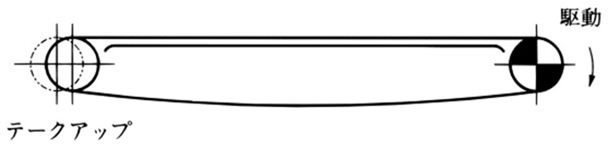
It has a short conveyor length and can be used at low speeds.
The tension caused by the mass of the chain on return-way can cause vibrations, which can prevent smooth transport.
3) return-way is supported by a guide or roller.
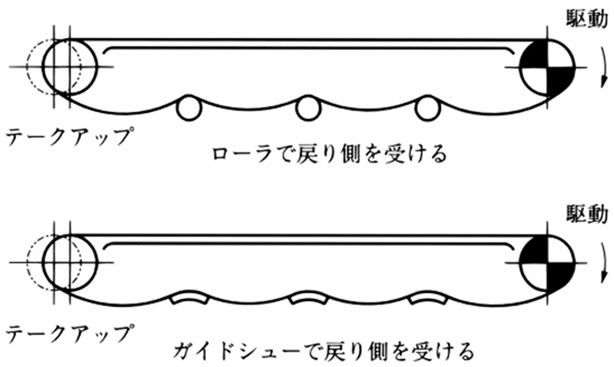
The chain comes into contact with the guides and rollers and articulate, which can accelerate wear and make it more susceptible to scratches.
Chain vibrations can also have a negative effect, and if conveyor length is long, they may be split and absorbed by the catenary.
4) return-way is entirely supported by the guide.
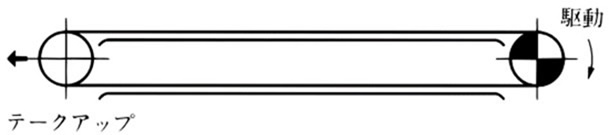
This method supports the entire return-way with rails and attaches a take-up to the driven sprocket to absorb the chain slack.It can also be used when there is reverse rotation.
However, since the catenary is not located at the point where it exits the drive sprocket, the chain must be periodically adjusted with a take-up to remove any tension.
Note: Please be careful not to overtighten the take-up as this can cause the chain to wear out faster.
5) Example where return-way is upward
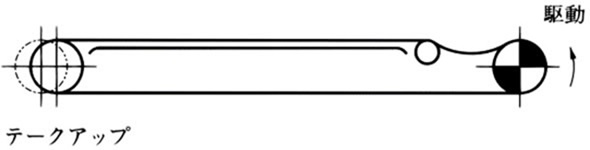
5.2 Vertical conveyance
If the machine is to be stopped while loaded, a brake or a "Tsubaki backstop cam clutch" must be installed in the drive section to prevent reverse rotation.
Note: Be careful not to overtighten the take-up as this can cause the chain to wear out faster.

5.3 Inclined transport
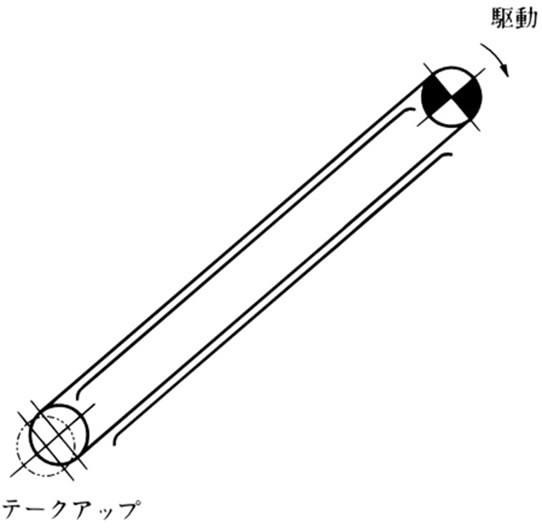
5.4 When the axis is vertical
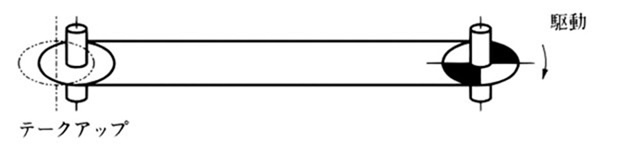
When the shaft is vertical, such as for horizontal circulation, attach guide rollers to the chain to ensure smooth movement of the chain.
| Important points to note when using conveyor chains |
|---|
|
6. Deciding on the specifications for bulk item material transport chain
The recommended chain specifications are listed below for reference based on the chain conveyor types and chain specifications used for transporting bulk item bulk items.
Depending on the conveyed item, the situation and properties may differ from those shown in Table 1 even if the name is the same, so please take past performance into consideration and give careful consideration before deciding on the conveyor type and chain specifications.
Table 1. Conveyed items and chain specifications
- 1. The abrasion resistance of conveyed objects decreases in the order of large → medium → small.
- 2. Corrosivity is indicated as strong acidity, acidic, neutral, alkaline, or strong alkaline.
- 3. When using the beauty specifications, please refer to the beauty specifications.
| Transported goods | Usable chain conveyor types | Recommended chain Specification Code |
Notes | |||||
|---|---|---|---|---|---|---|---|---|
| Name | Abrasion resistance | Corrosive | scraper Conveyor |
flow Conveyor |
apron Conveyor |
bucket elevator |
||
| rice | Small | neutral | ○ | ○ | ○ | DT | ||
| barley | Small | neutral | ○ | ○ | ○ | 〃 | ||
| wheat | Small | neutral | ○ | ○ | ○ | 〃 | ||
| soy | Small | neutral | ○ | ○ | ○ | 〃 | ||
| corn | Small | neutral | ○ | ○ | ○ | 〃 | ||
| flour | Small | neutral | ○ | ○ | ○ | 〃 | ||
| starch | Small | neutral | ○ | △ | △ | 〃 | ||
| Cane (sugar cane) | Small | neutral | ○ | ○ | DTA | |||
| Bagasse | Small | neutral | ○ | DTA | ||||
| refined sugar | Small | neutral | ○ | ○ | ○ | SS | Note) See 3. | |
| rock salt | Small | neutral | ○ | △ | △ | DT | ||
| mixed feed | Small | acidic | ○ | △ | △ | 〃 | ||
| Soda ash | Medium | Strong alkaline | ○ | △ | △ | 〃 | ||
| carbide | Medium | ○ | ○ | ○ | ○ | 〃 | ||
| Glauber's Salt | Medium | acidic | △ | GS | ||||
| Quicklime (dry) | Medium | Strong alkaline | ○ | △ | △ | DT | ||
| Slaked lime (dry) | Small | Strong alkaline | ○ | △ | △ | 〃 | ||
| polyethylene | Medium | neutral | ○ | △ | △ | 〃 | ||
| PVC powder | Medium | △ | △ | MT | ||||
| carbon | Medium | neutral | ○ | △ | △ | BT | ||
| activated carbon | Medium | neutral | ○ | △ | △ | DT | ||
| Ammonium salt (dry) | Small | neutral | ○ | △ | △ | 〃 | ||
| Ammonium sulfate (dry) | Medium | acidic | ○ | △ | △ | 〃 | ||
| Urea powder (dry) | Small | neutral | ○ | △ | △ | 〃 | ||
| Urea powder (wet) | Medium | Strong alkaline | ○ | △ | △ | GS | ||
| Synthetic detergent | Medium | neutral | ○ | △ | △ | DT | ||
| Plaster (wet) | Medium | Strong acidity | ○ | ○ | ○ | GS・RT | ||
| Dolomite | Medium | alkaline | ○ | △ | ○ | △ | DT | Apron conveyor DTA Series |
| Limestone (dried) | Medium | alkaline | ○ | △ | ○ | △ | 〃 | Apron conveyor DTA Series |
| Clay (dry) | Medium | neutral | △ | △ | BT | |||
| cement clinker | large | Strong alkaline | ○ | △ | ○ | △ | CT | |
| cement products | Medium | Strong alkaline | ○ | ○ | CT | |||
| Wood chips (dried) | Small | alkaline | ○ | △ | DT | |||
| Sawdust (dry) | Small | alkaline | ○ | △ | DT | |||
| coal | Medium | acidic | ○ | ○ | CT | |||
| Coke | large | neutral | ○ | △ | BT | |||
| alumina | Medium | Strong alkaline | △ | △ | CT | |||
| Foundry sand | large | neutral | ○ | △ | BT | |||
| scale | Medium | neutral | ○ | △ | △ | BT | ||
| Coke dust | large | neutral | △ | BT | ||||
| Lime dust (wet) | Medium | acidic | △ | BT | ||||
| Clinker dust | large | Strong alkaline | △ | BT | ||||
| food waste | Medium | △ | ○ | RT | ||||
| Municipal waste incineration ash (normal temperature/dry) |
Small | alkaline | ○ | DTA | ||||
| Municipal waste incineration ash (including water) |
Small | alkaline | ○ | RT | ||||