technical data Power-Lock Selection and Procedure
If you would like to see the selection procedures and important points, please proceed below.
If you would like to narrow down or tentatively select a product series,
Please click here.
If your usage conditions have been decided and you would like a detailed selection,
Please click here.
SL Series Selection
1. Check the maximum torque and thrust load
The maximum torque and thrust load are calculated by Service factor in the transmission capacity.
*When connecting a servo motor or stepping motor, use the maximum torque (peak torque) of each as the maximum generated torque (Tmax).
| SI units |
|---|
|
Tmax = 9550 × H n ・f Tmax = Maximum torque (N・m)
|
| Gravity Units |
|---|
|
Tmax = 974 × H n ・f Tmax = Maximum torque (kgf・m)
|
Pmax = Pax・f
- Pmax: Maximum thrust load kN{kgf}
- Pax: Thrust load kN{kgf}
- f: Service factor
f: Service factor
| Load Condition | Service factor | |
|---|---|---|
| Smooth load without shock | Small inertia | 1.5~2.5 |
| Light shock load | Medium inertia | 2.0~4.0 |
| High impact loads | Large inertia | 3.0~5.0 |
When only torque is applied
Compare the Tmax obtained above with the catalog transmission torque Mt.
Mt ≧ Tmax → Can be used.
Mt < Tmax → Consider increasing the model number.
When torque and thrust load are applied simultaneously
The combined load M R is calculated and compared with the transmitted torque M t.
MR = Tmax2 + (Pmax × d 2 )2
- Tmax: Maximum torque N・m{kgf・m}
- Pmax: Maximum thrust load N{kgf}
- d: shaft diameter m
Compare the M R calculated above with the catalog transmission torque Mt.
M t ≧ M R → Can be used.
M t < M R → Consider increasing the model number.
*This series cannot be used in multiple units.
2. Consideration of the axis and boss
(1) Consideration of material strength
A large surface pressure acts on the shaft and boss when fastened. For this reason, the shaft and boss should be made of a material with a strength that satisfies the following formula.
σ0.2S≧ 1.2 × P σ0.2B≧ 1.2 × P'
- P: Shaft side pressure MPa{kgf/mm2}
- P': Boss side pressure MPa{kgf/mm2}
- σ 0.2S: Yield stress of shaft material used MPa{kgf/mm2}
- σ 0.2B: Yield stress of the boss material used MPa {kgf/mm2}
Please refer to the steel material strength table, which shows the yield point values of representative steel materials.
(2) Boss strength considerations
The boss will generate a combined stress due to the applied torque and surface pressure. Calculate this combined stress using the following formula.
- (a) Normal stress (σ w) generated in the boss
σW = - P MPa{kgf/mm2}
P: Shaft side pressure MPa{kgf/mm 2}
- (b) Tangential stress (σ t) generated in the boss
σt = P(1 + Q2) - 2 × P' 1 - Q2 MPa{kgf/mm2}
Q = dW d
P: Shaft side pressure MPa{kgf/mm 2}
P': Pressure on outer hub diameter MPa{kgf/mm 2}
d W: Shaft diameter mm d: outer hub diameter mm
- (c) Shear stress due to torsion of the boss (τB)
τB = 1600 × Tmax・d π(d4 - dW4) MPa{kgf/mm2}
Ensure that the yield stress (σ 0.2B) of the boss material you use is σv < σ0.2B.
(3) Consideration of the inner diameter of the hollow shaft
When using a hollow shaft, calculate the hollow shaft inner diameter using the following formula.
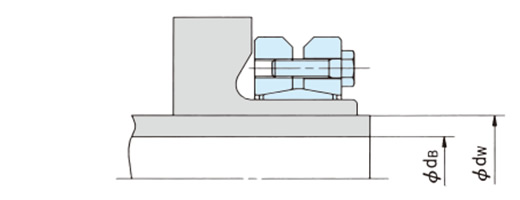
dB ≦ dW σ0.2S - 1.6 × P σ0.2S
- d B: Maximum allowable hollow shaft inner diameter mm
- d: shaft diameter mm
- σ0.2S: Yield point of shaft material MPa{kgf/mm 2}
- P: Shaft side pressure MPa{kgf/mm 2}