technical data Top chain handling
This page is about Plastic modular chain (mold-to-width) and Plastic modular chain (wide width).
This is a common page for both Top chain and Plastic block chain products.
Top chain installation and inspection
1. Installing the sprocket
The quality of sprocket installation has a major impact on the smooth operation of the conveyor and determines the life of the chain.
Please install correctly according to the following procedure.
1) Use a spirit level to make sure the shaft is level.
The accuracy is adjusted to within ±1,300.
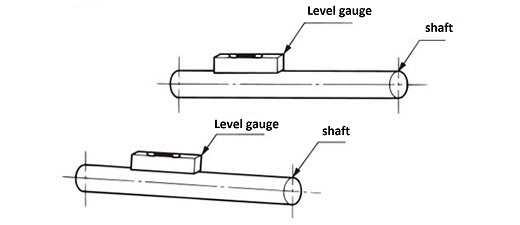
2) Determine the parallelism of the shaft.
The accuracy of ABL is adjusted to within ±1,100.
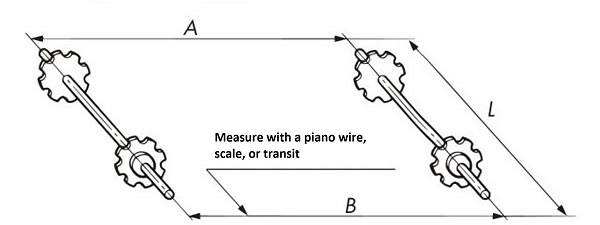
3) Correct the misalignment of a pair of sprockets.
- Up to 1m shaft distance: within 1mm
- Center distance 1m to 10m: Center distance (mm) within 1000
- Center distance 10m or more: within 10mm
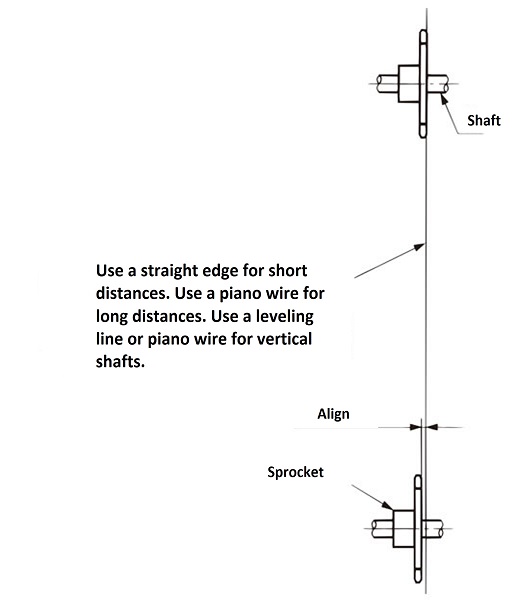
4) After adjusting steps 1) to 3), secure the sprocket to the shaft using a key, Tsubaki Power-Lock, etc.
Sprockets used in parallel are fixed so that the two teeth on the shaft center are in phase.
2. Inspection
During the initial break-in period, frequent inspections should be carried out to make adjustments. Check the following items:
- 1) Abnormal chain wear
- 2) Chain slack
- 3) Flatness of the chain surface
- 4) Difference in top plate surface between adjacent chains
- 5) Foreign matter between the top plates, spacing between the top plates
- 6) Chain pulsation and jerking
-
7) Abnormal wear of the sprocket, abnormal contact scratches due to runout, accumulation of dirt on tooth root of the sprocket teeth
When the sprockets are properly engaged, they are in uniform contact as shown in the diagram at A.
If the chain is uneven like B, it may be due to improper installation of the sprocket or a twisted chain, so please re-inspect the chain.
The normal contact position is slightly above tooth root (valley).
However, if initial tension is applied and tension remains on the slack side, there will be slight contact with tooth root (valley), but even in this case, the strongest contact will be at position A. In the case of idlers and tighteners, the contact will be at the center of tooth root (valley).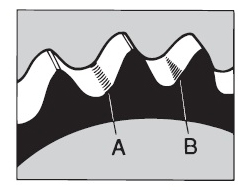
- 8) Excessive wear of the rail
- 9) Abnormality in the lubrication system
Causes of chain pulsation, jerking, and abnormal wear
- 1) Overload, glass fragments or jammed crown
- 2) Chain waviness on return-way
- 3) Insufficient or no lubrication
- 4) Interference between top plates
- 5) Sprocket wear
- 6) Irregular chain wear or breakage
3. Lubrication
Lubrication significantly reduces chain elongation, sprocket wear, and top plate and rail wear.
The use of lubricants also reduces noise and power loss during transport.
Plastic chains are self-lubricating, but lubrication can provide similar benefits.
In this case, the most desirable thing is to use a good quality lubricant, but when oil cannot be used, special lubricants or soap are often used.
Be sure to apply sufficient amounts of these lubricants to the areas where wear occurs as described above.
4. Cleaning
During normal use, chain Wear debris, grease, dust, spilled syrups, and other contaminants can easily accumulate on the chain, making it necessary to clean the chain and conveyor, resulting in the following undesirable consequences:
- 1) Contamination, scratches, falling, and slippage of transported items
- 2) Increased load on the chain and motor
- 3) Accelerates wear of sprocket teeth
- 4) Pulsation or jerking of the conveyor
- 5) Accelerates wear on the top plate and bends of the chain
- 6) wearstrip wear out quickly
- 7) Increase in bacteria and germs
*When Top chain is operated, wear debris is generated.
This can occur frequently, especially during the initial settling period, so please clean regularly.
How to secure a sprocket for Plastic top chain
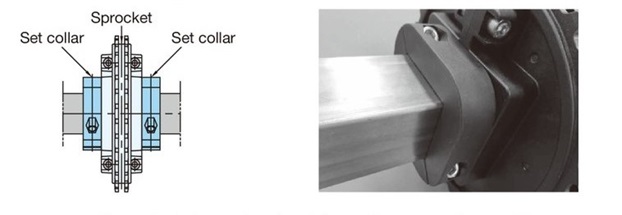
Place the set collars on both sides of the sprocket without any gaps, and then tighten the bolts to the required torque to secure them in place.
How to fix the idler
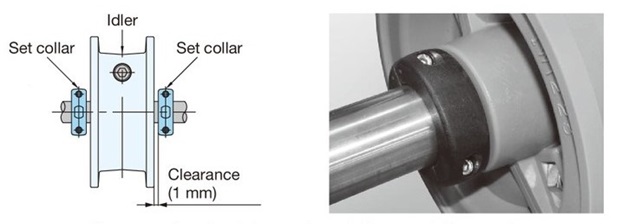
Place the set collars on both sides of the idler and tighten the bolts to the required torque to secure them in place.
At that time, make sure there is a gap and the idler rotates.
Please refer to the set color for details.
5. Chain, sprocket and wearstrip replacement criteria
5-1. Chain
| item | Inspection method | Judgment criteria(※) | ||||||||||||||||||||||||||||||||||||||
|---|---|---|---|---|---|---|---|---|---|---|---|---|---|---|---|---|---|---|---|---|---|---|---|---|---|---|---|---|---|---|---|---|---|---|---|---|---|---|---|---|
| Chain wear elongation | To eliminate play in the entire chain With the chain tensioned to some extent Measure the length of the 10 top plates with a tape measure. 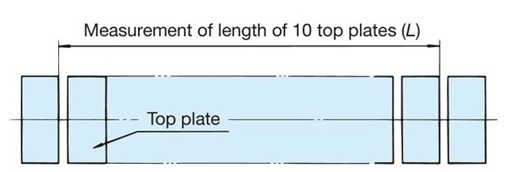
|
Reference length = chain pitch x 10 Example: Measurement results for 10 TTP type links (reference length 381 mm) Elongation rate and judgment when the measurement length was 387 mm Growth rate X = (387 - 381) ÷ 381 × 100 ≒ 1.6% Based on the table above, the rating is B. |
||||||||||||||||||||||||||||||||||||||
| Top plate wear (Plastic top chain Stainless steel Top chain only) |
The thickness of the top plate that slides against wearstrip is Measure with a vernier caliper. In addition, if the conveying surface has unevenness of 1 mm or more Please check if this is occurring. |
|
||||||||||||||||||||||||||||||||||||||
| Link height wear (plastic Modular Chain) |
The height of the link that slides with wearstrip or transported object is Measure with a vernier caliper. 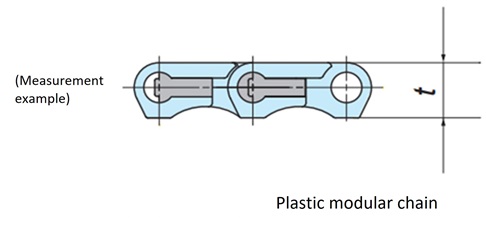
|
|
||||||||||||||||||||||||||||||||||||||
| Link height wear (Plastic block chain) |
The height of the link that slides with wearstrip or transported object is Measure with a vernier caliper. 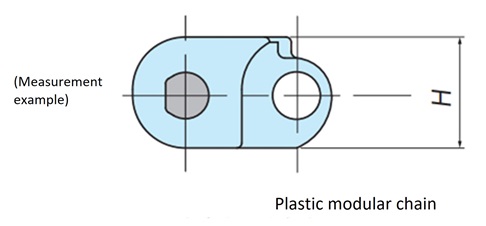
|
|
||||||||||||||||||||||||||||||||||||||
| corrosion | Check whether the chain has any poor bending due to corrosion. If corrosion is progressing, remove the rust and Measure the thickness of the link plate with a vernier caliper. |
|
||||||||||||||||||||||||||||||||||||||
| Top plate deformation | Damaged bottles, caps, etc. Deformation of the top plate, lifting of the curled part, The play between the top plate and the rivets, and the top surface of the top plate Check for any abnormal scratches. |
Please replace it if it is deemed to be interfering with transportation. Regarding abnormal scratches on the top surface of the top plate Please investigate the cause of return-way rail etc. and repair it. |
||||||||||||||||||||||||||||||||||||||
| Roller chipping, and poor rotation |
Check for missing rollers and roller rotation. | If there are any missing rollers, rollers that are not rotating properly, or rollers that are heavily worn on one side, Replace the chain and rollers. |
||||||||||||||||||||||||||||||||||||||
(※) A: Can continue to be used. B: There is still some margin for improvement up to the limit of use, but preparations for replacement should be considered. C: Replacing the product is necessary after reaching the limit of use.
Note: Please contact us for the standards for link height wear of the TPUN type.
5-2. Sprocket
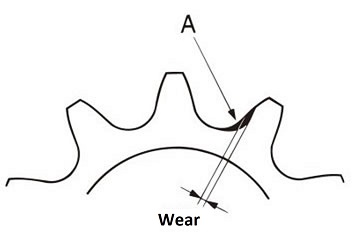
When the sprocket wears down as shown in the diagram on the right (left), the chain gets caught on the tip of the teeth A, making it difficult to release, causing the chain to vibrate.
The amount of wear tolerance varies slightly depending on the conveyor type and chain size, but if you replace the chain when it has worn down to about 1.5 to 2 mm, it will not damage the chain.
Also, if the sprocket is worn in the tooth width direction as shown in the diagram on the right (right), the shaft centering is incorrect and should be corrected.

5-3.Running wearstrip
Replace wearstrip when it has worn down to half its original thickness.