technical data Small size conveyor chain Handling
Points to note when using free flow chains
1. Double Plus Free Flow Chains (common with snap cover)
- (1) The recommended conveyor conveyor length is 15m or less.
- (2) When using Plastic Roller, avoid using them in an environment where they may be exposed to oil or water. (This may reduce the speed-up function.)
- (3) Avoid dropping pallets or workpieces or pressing down on them from above, thereby subjecting the chain to shock or pressure.
- (4) Do not use Double Plus Free Flow Chains with Plastic Roller without lubrication. If the expected life is not met, consider using a lambda chain.
- (5) Steel rollers must be oiled to prevent an abnormal increase in the coefficient of friction.
Additionally, if abnormal noise occurs at the sprocket bend or between the large and small diameter rollers in the conveying area due to deterioration over time, apply SAE 10 to 20 oil between the pin and bushing and between the large and small diameter rollers. Use a spray oiler or a brush to apply the oil so that it reaches the areas that need it. If problems arise due to oil transferring to the conveyed item, wipe off any oil that has adhered to the outer circumference of the roller.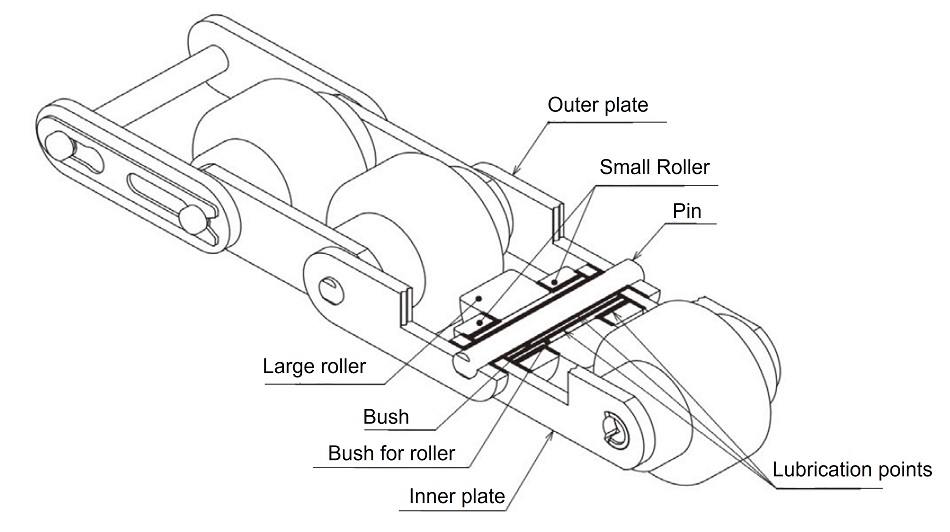
The lambda specification reduces noise between the pin and bushing, so please consider using it in places where lubrication is not possible or where lubrication is undesirable.
- (6) Processing the top surface of the frame end on the conveying side
Please chamfer the running surface of the small diameter rollers of the chain.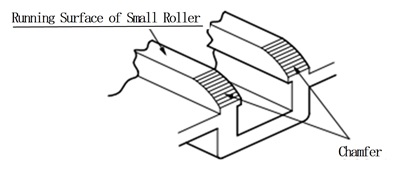
- (7) Large diameter roller holder
By attaching a "large diameter roller support" to the driven end, it is possible to prevent the chain (large diameter roller) from sinking in the chamfered section.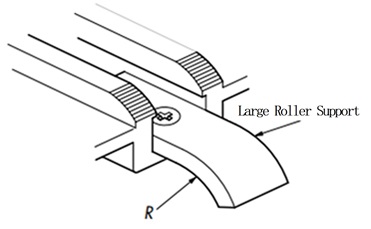
- (8) Processing between conveyors (straight line transfer)
At the transfer point of the conveyor, install free rollers or motor rollers as "pallet support rollers" to transport the pallet in a stable state.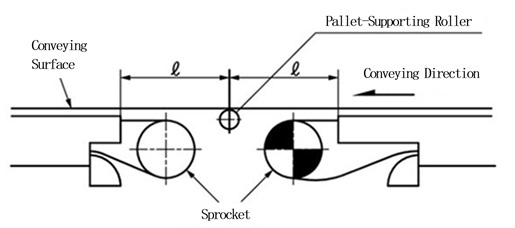
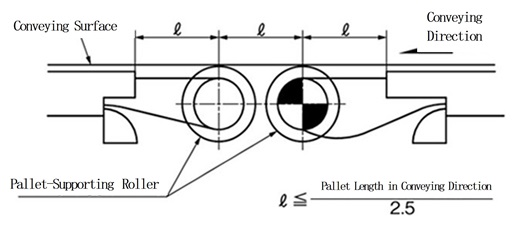
- (9) Take-up (1)
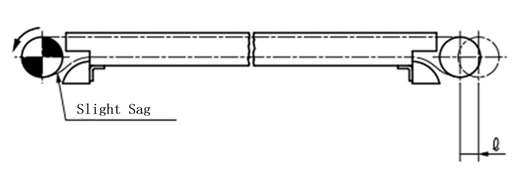
Take-up amount ℓ = Chain pitch x 2 + Leeway length
When operating, allow a small amount of slack in the chain below the drive sprocket (about 10% of the span).
If the slack becomes too great, adjust the take-up or shorten the chain.
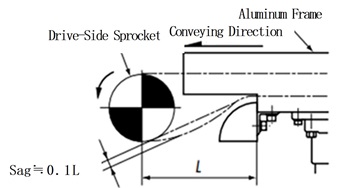
Chain slack
Unit: mm Size Normal sagging Maximum sag RF2030 25 75 RF2040 35 105 RF2050 40 120 RF2060 50 150 RF2080 65 190 This is the sag based on the double speed conveyor design data.
- (10) Take-up (2)
If there are conveyors in front and behind and you cannot install a take-up like the one on the previous page, please refer to the diagram below.
However, in the case of Double Plus Free Flow Chains with a snap cover, make sure that the R dimension is larger than the R dimension of the return guide (see dimension diagram).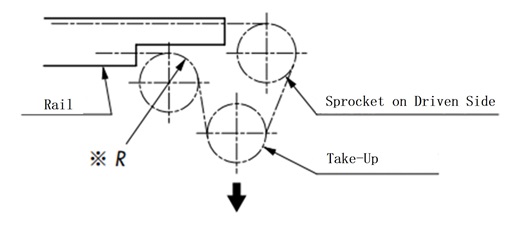
- (11) Sprocket and shaft
Drive sprocket...The left and right sprockets are keyed and must be aligned in phase.
Take-up sprocket...No key (free) and has separate left and right shafts.
Other sprockets...no key (free)
⚠Please note that if the transported item is placed directly on the chain, the large diameter rollers will leave marks on the transported item.
*RF2030VRPUA and UB (urethane lined rollers) are designed to leave relatively few roller marks even when conveyed items are placed directly on the chain.
2. Double Plus Free Flow Chains with snap cover
- (1) The snap cover is made of engineering plastic, so please handle it carefully.
- (2) There are two types of snap covers, one for outer link and one for Inner link. Be careful not to install them incorrectly (see diagram below).
(The snap cover is shipped assembled with the chain.)
Snap cover for outer link
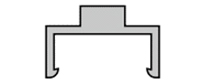
Snap cover for Inner link
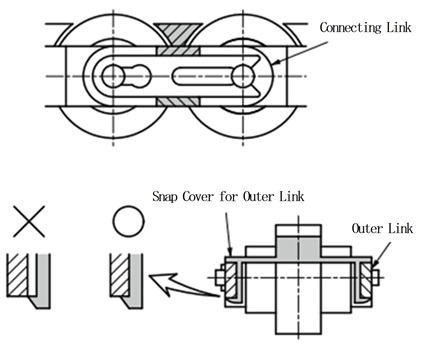
- (3) When connecting chains, first use the dedicated connecting links, then properly attach the snap covers for outer link to the notches in the plates (see diagram below).
- (4) If the snap cover is damaged during handling, replace it with a new one.