technical data Reducer Worm Reducer Motor Specifications
Regarding inverter drive (when driving a standard motor with an inverter)
1. Frequency range
Maximum 120Hz. In the low Hz range (low frequency), please use within the inverter's allowable range.
2. Torque characteristics
周波数とトルク特性は下図を参考にしてください。- ・At high speeds, torque decreases in inverse proportion to rotation speed because kW remains constant. Also, as rotation speed increases, motor noise, motor fan noise, reduction section noise, vibration, etc. increase.
- - In the mid-speed range, the torque characteristic is almost constant.
- At low speeds, the motor's operating efficiency and cooling effect decrease, resulting in a large temperature rise. To prevent this, reduce the torque as shown in the diagram below.
(0.1 to 0.4kW only)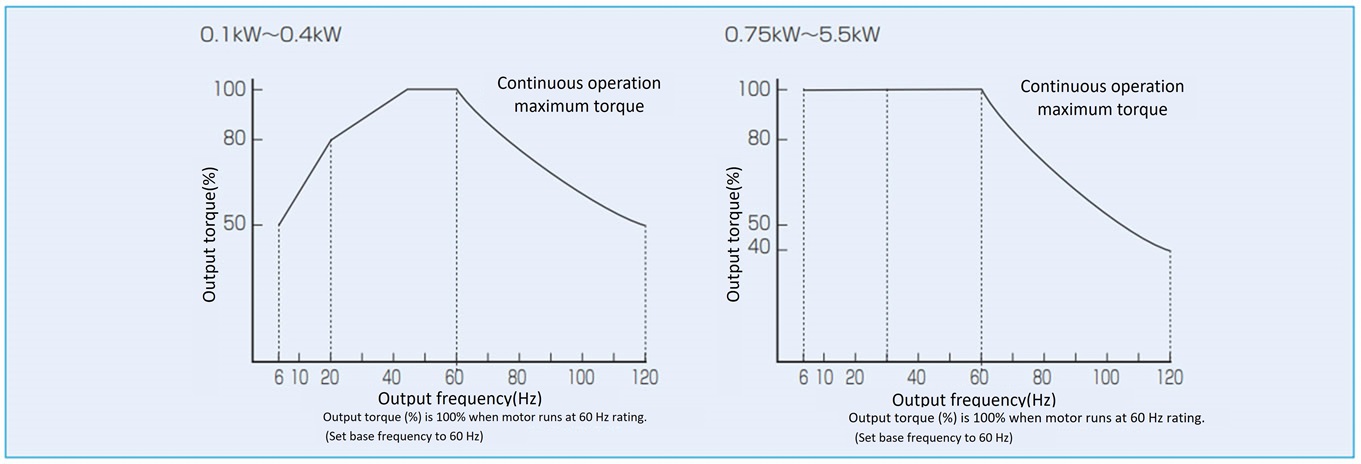
Note: The torque characteristics above are for the motor alone.
In practice, please take into account the efficiency of Troi Drive and Worm Power Drive.
3. With brake
- - Because the brake requires a specified power source (frequency, voltage), refer to the wiring diagram and operate the brake circuit separately. With standard products, the brake lead wires are shipped screwed to the motor lead wires, but remove the screws and connect them separately.
- - When braking, please do so at 60Hz (1800 r/min) or less. Braking at high speeds above 60Hz may cause mechanical damage or abnormal wear to the brake lining, so be sure to operate at 60Hz or less.
- ・At low speeds, the cooling capacity may decrease, which may shorten the heat resistance life. In this case, reduce the time that the brake power is on.
4. Precautions
- - At low frequencies and above 60Hz, reduce the torque as shown in the diagram above.
- - When a 400V class motor is driven by an inverter, insulation breakdown may occur due to the effects of high voltage surges (microsurges) generated by inverter switching. Therefore, measures to prevent this (microsurge countermeasures) are required for the motor, and standard 400V class motors are equipped with microsurge countermeasures even if not instructed otherwise. However, if the level exceeds 1250V, please install a suppression filter or reactor on the inverter side.
- - Temperature rise, noise and vibration will be greater than when using commercial power.
- To protect the motor from overheating, set the electronic thermal to general-purpose motor characteristics or install a thermal relay between the inverter and motor.
- When using a base frequency of 50Hz, the output torque should be 0.8 times the value in the table above (only for 0.4kW or less).
- ・The motor may resonate depending on the rotation speed and frequency. When operating continuously, change the inverter carrier frequency settings to avoid the resonant frequency.
- - If the load is light during a test run, a large current value may be output at low frequencies. This is due to the characteristics of the motor and is not abnormal. The current value can be reduced by changing the inverter settings (reducing torque boost, lowering the V/F ratio, torque vector control).
- ・Continuous operation at frequencies above 60Hz will cause the reducer to generate a lot of heat, so please avoid this. Please contact us for details.
With inverter motor
Inverter-compatible motors of 0.1kW to 0.4kW are available as options. Please contact us for details.