technical data Drive chain Roller Chain Handling
3. Roller chain lubrication
Lubrication is extremely important in roller chain transmissions. The more severe the conditions under which the chain is used, the more important lubrication becomes.
If lubrication is insufficient, even a highly designed transmission device will not be able to last its entire lifespan. Depending on the conditions of use, the device may reach the end of its lifespan in an extremely short period of time.
- 1. The main purpose of oiling and greasing is to reduce chain wear and elongation and prevent corrosion.
Wear elongation occurs due to wear between the pin and bushing at the bend. - 2. The anti-rust lubricant used in some roller chains is a high-quality oil that has anti-rust and lubricating properties.
It prevents wear that tends to occur in the early stages of operation and is compatible with lubricating oil to ensure wear resistance. - 3. Do not wipe off the oil that has been applied to the roller chain with a cloth or wash it off with detergent.
3.1 Lubrication location
- 1. Roller chain elongation due to wear occurs between the pins and bushings. Lubrication should be applied to this area.
- 2. On the slack side of the roller chain, lubricate the gap between the outer and inner plates. At the same time, lubricate the gap between the bushing and roller.
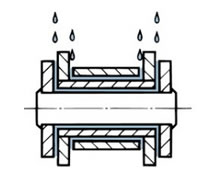
Figure 12. Oil fill location
3.2 Hanging
- 1. Generally, there is no slack on the roller chain, but lubrication should be performed with as little load as possible applied to the roller chain.
- 2. After oiling the roller chain in the non-flexible sections, apply a thick layer of grease around the roller chain to prevent corrosion. Also oil the joints with End fixture.
- 3. If a roller chain used outdoors is exposed to rain or snow, oils and grease will wash away and cause corrosion. Install protective gear such as a cover.
If exposed to rain or snow, remove the moisture, then quickly oil the roller chain and apply a thick layer of grease on top of it.
3.3 Types of lubricating oil
Recommended SAE Number
| Chain number | Lubrication type | |||||||
|---|---|---|---|---|---|---|---|---|
| AI・AII・B | C | |||||||
| Ambient temperature | Ambient temperature | |||||||
| -10℃~0℃ | 0℃~40℃ | 40℃~50℃ | 50℃~60℃ | -10℃~0℃ | 0℃~40℃ | 40℃~50℃ | 50℃~60℃ | |
| Small pitch below RS50 | SAE10W | SAE20 | SAE30 | SAE40 | SAE10W | SAE20 | SAE30 | SAE40 |
| RS60・80 | SAE20 | SAE30 | SAE40 | SAE50 | ||||
| RS100 | SAE20 | SAE30 | SAE40 | SAE50 | ||||
| Large pitch of RS120 or more | SAE30 | SAE40 | SAE50 | |||||
3.4 Lubrication type and oil supply method
Stop driving and then lubricate.
To check the oil supply status, remove the chain and inspect the surface condition of the pins and bushings at the joints.
If you observe erosion or wear on the surfaces of pins or bushings, as well as red or dark brown surfaces, this generally indicates insufficient lubrication.
| Lubrication type | Method | Lubrication amount | |||||||||||||||||||||||||||||||||||
|---|---|---|---|---|---|---|---|---|---|---|---|---|---|---|---|---|---|---|---|---|---|---|---|---|---|---|---|---|---|---|---|---|---|---|---|---|---|
| A | I |

This method involves oiling the pins on the slack side of the roller chain and the gaps between Inner link with an oil can or brush. |
Oil with sufficient frequency (in general about once every 8 hours) so that the roller chain bearings do not dry out. |
||||||||||||||||||||||||||||||||||
| II |
Drip lubrication 
This method uses a simple case and drips oil sent from an oil tank such as an oil cup. |
For single strand roller chain, oil should be supplied at a rate of 5 to 20 drops per minute. Also, the faster the speed, the more drips will be dispensed. |
|||||||||||||||||||||||||||||||||||
| B |
Oil bath lubrication 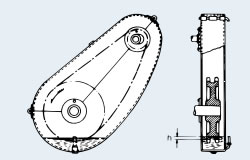
This method uses a case that does not leak oil and runs the engine through oil. |
If the depth h from the oil surface to the lowest point of the roller chain is too great, the oil may heat up to 80°C or more and deteriorate. Set the depth of the roller chain in oil to about h = 6 to 12 mm. |
|||||||||||||||||||||||||||||||||||
|
Rotating plate oil supply 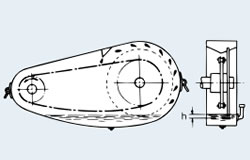
This method involves applying oil to the chain using a rotating plate mounted inside a case that prevents oil leakage. The peripheral speed of the rotating plate must be 200 m/min or more. If the chain width is 125mm or more, attach a rotating plate to both sides. |
The bottom of the rotating plate should be lowered to about h=12 to 25 mm below the oil surface. Roller chains should not be submerged in oil. |
||||||||||||||||||||||||||||||||||||
| C |
Forced Pump Lubrication 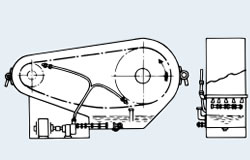
This method uses a case that prevents oil leakage and uses a pump to circulate and cool the oil while forcibly supplying it. When the chain has n strands, n+1 oil holes are required to target the gaps in each section. |
Approximate oil supply amount per oil supply hole (L/min)
|
|||||||||||||||||||||||||||||||||||