technical data Small size conveyor chain Handling
Inspection
During the initial break-in period, please inspect the following items as necessary to make adjustments.
- (1) Abnormal wear of the chain.
- (2) Chain slack.
- (3) Chain pulsation and jerking.
- (4) Abnormal wear on the sprocket, abnormal contact marks due to runout, or accumulation of dirt on the sprocket tooth root. When the sprockets are properly engaged, they are evenly contacting as shown in the diagram at A. If they are unevenly contacting as shown at B, this is due to improper installation of the sprocket or a twisted chain, so please re-inspect. The normal contact position should be slightly above tooth root (valley). However, if initial tension is applied and tension remains on the slack side, there will be slight contact with tooth root (valley), but even in this case, the strongest contact will be at position A. In the case of idlers and tighteners, the contact will be at the center of tooth root (valley).
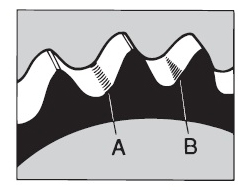
Figure 28. Sprocket tooth contact
- (5) Excessive wear of guide channel.
- (6) Abnormality in the lubrication system.
-Causes of chain pulsation, jerking, and abnormal wear
- (1) Overload or jamming of debris.
- (2) Backbending of the chain on the return trip.
- (3) Insufficient or no lubrication.
- (4) Sprocket wear.
- (5) Irregular wear or breakage of the chain.
Tension adjustment
The chain tension needs to be left with an appropriate amount of slack so that it is not too tight.
Too much tension on the chain will accelerate wear, and too much slack will cause the chain to ride up onto the sprocket teeth, resulting in a malfunction.
1. Frequency of adjustment
Chains elongate due to initial elongation until they break in (initial elongation) and due to wear of the sliding parts between the pins and bushings after use. Therefore, to always maintain the appropriate chain tension, it is necessary to make appropriate adjustments by taking up the chain.
The table below shows the approximate frequency of chain inspection and adjustment based on an 8-hour operation per day. When used for long periods of time, it is easy to neglect to inspect the take-up, which can cause the chain to sag and lead to an accident, so be sure to inspect it regularly. If you operate for long periods of time, shorten the inspection intervals.
| Within one week of starting operation | Once daily |
| Within one month | Twice a week |
| After one month | Twice a month |
2. When you can't adjust the take-up
If there is still slack in the chain even after fully shortening the take-up, remove two links to shorten the overall length.
The procedure is based on the "cut and connect and joining procedure" (see here).
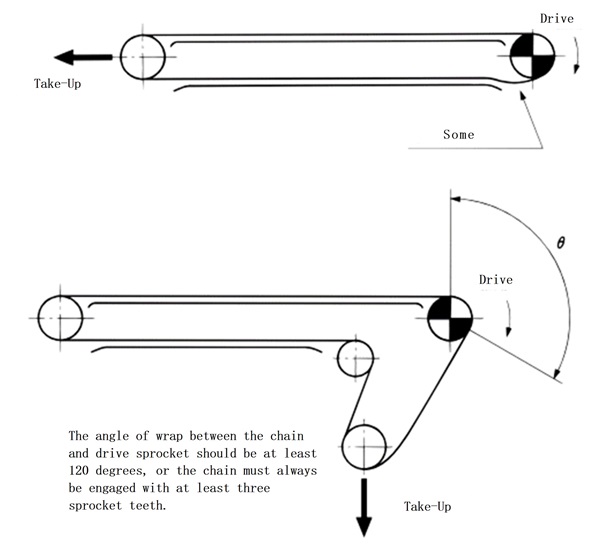
Figure 27. Adjusting the chain slack
3. Adjust the take-up evenly on both sides
If the two-strand chain has separate take-ups, make sure that the adjustment stroke is the same on both sides (this is not necessary with linked take-ups or balanced take-ups).
If the left and right chains are adjusted unevenly, the chain plates will come into contact with the sides of the sprocket teeth, causing an excessive load.If the left and right chains are not adjusted evenly, try swapping part of the left and right chains to make them even.