technical data Small size conveyor chain Chain Types, How to Use Them, and Structure
Small size conveyor chain can be broadly divided into RS Attachment Chains Double pitch, each of which can be used according to its characteristics.
RS type chain with attachments and double pitch Double pitch
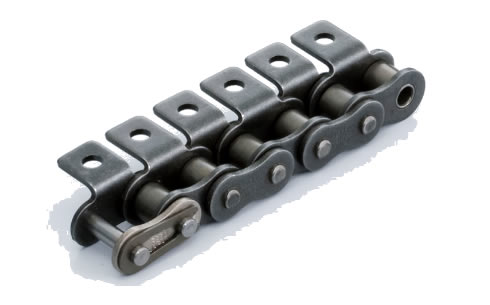
RS Attachment Chains
- - Smooth bending allows for faster conveying speeds.
- - RS-type standard sprockets can be used, allowing for a compact design.
- - Relatively high accuracy.

Double pitch
- - R rollers can be installed, which have high transport efficiency and can withstand large loads.
- - The attachments are wide and you can choose the number of holes.
- - The number of links per meter is halved because it is Double pitch, and the number of links per length is reduced, making it cheaper.
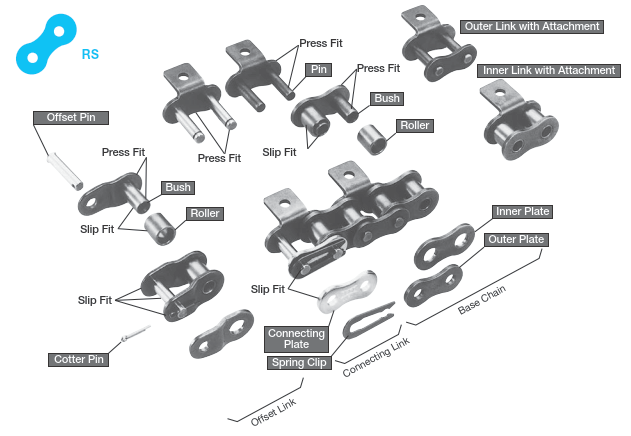
Structure of RS Attachment Chains
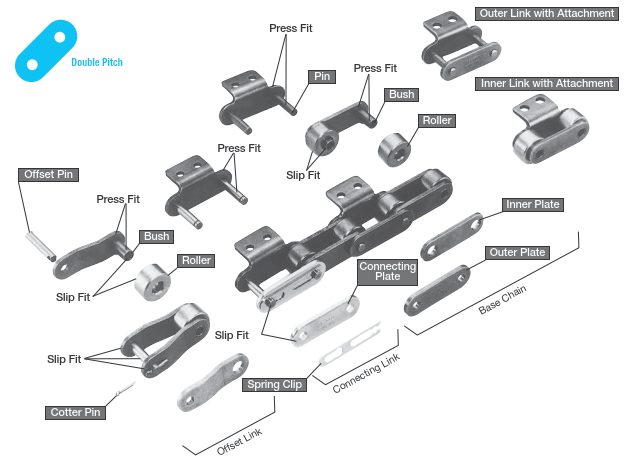
The chain body consists of five parts: pins, bushings, rollers, and inner and outer plates.
The basic structure is the same as that of Drive chain.
| Features of the RS type structure with attachment | |
|---|---|
| Roller | ・S roller only. |
| Inner and outer plates | - RS type figure eight shape. |
| Sprocket | - RS standard sprockets can be used in most cases. |
Double pitch Structure
The chain body consists of five parts: pins, bushings, rollers, and inner and outer plates.
The basic structure is the same as that of Drive chain.
| Double pitch structure features | |
|---|---|
| Roller | -Available in S rollers and R rollers. |
| Inner and outer plates | - Flat shape with twice the pitch of the RS type. |
| Sprocket | - R rollers require a special sprocket. - S rollers with 30 or more teeth can be used with RS standard sprockets. |
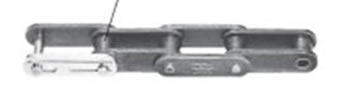
S Roller
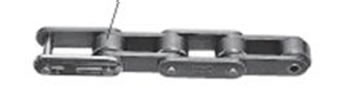
R Roller
How to use R rollers and S rollers
For Double pitch, two types of rollers can be selected: R roller and S roller.
| chain weight |
Roller Allowable Load |
Roller wear | When the roller rotates Friction coefficient |
Required power | conveyor length | Chain Speed | |
|---|---|---|---|---|---|---|---|
R Roller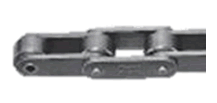
|
large (1.5) |
large (5) |
Small | small (1) |
Small | 10m or more | 20m/min or more |
S Roller
|
small (1) |
small (1) |
large | large (1.8) |
large | 10m or less | 20m/min or less |
R rollers have the advantage of a large allowable load and low friction resistance.
Also, the outer diameter of the roller is larger than the width of the plate.
S-rollers have the effect of reducing shock and wear when the sprockets mesh.
Although the rolling resistance is greater than that of R rollers, it is possible to reduce weight.
The roller outer diameter is smaller than the plate width.