
Principle of Double Plus Free Flow Chains
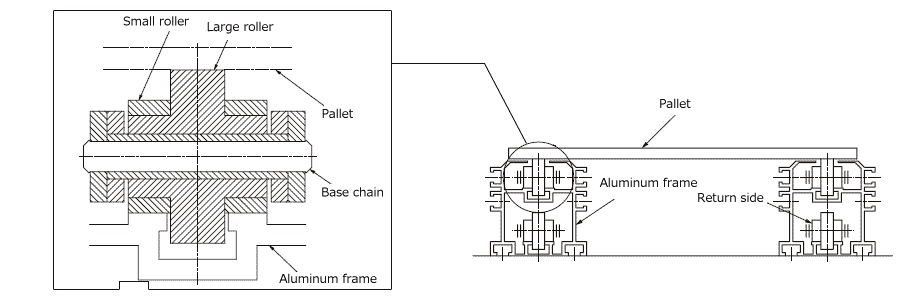
During transportation
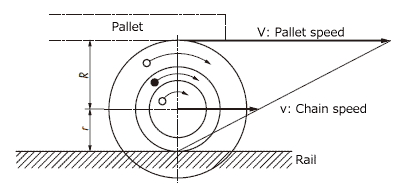
・Chain speed: ν
・Pallet speed: V
・Small roller radius: r
・Large diameter roller radius: R
The friction between the large diameter roller (marked with a circle) and the small diameter roller (marked with a circle) causes them to rotate in the same direction.
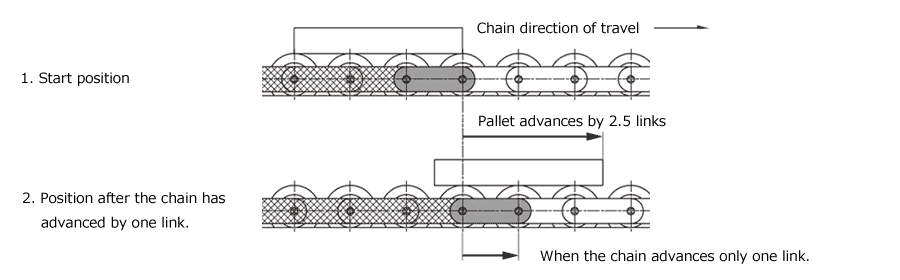
Due to the roller diameter ratio, the transported goods speed is 2.5 times the chain speed.
When the chain runs at a speed ν, the peripheral speed of the small diameter rollers (rolling speed of the rail running surface) is ν.
At this time, the large diameter roller and the small diameter roller rotate at the same angular velocity,
The peripheral speed of the large diameter roller is calculated from the radius ratio (R/r) × ν.
Therefore, the speed of the transported object, V, is the sum of the peripheral speed (R/r) x ν and the chain speed ν.
V=(R/r)×ν+ν
V=(R/r+1)×ν
Here, the ratio of radii (R/r) is ≒ 1.5,
V≒(1.5+1)
ν≒2.5ν
Chain and pallet position during transport
When accumulating
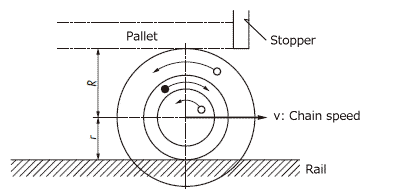
Since the braking force acts on the large diameter roller (marked with a circle),
The large diameter roller and the small diameter roller (marked with ●) slip between them, resulting in free flow.